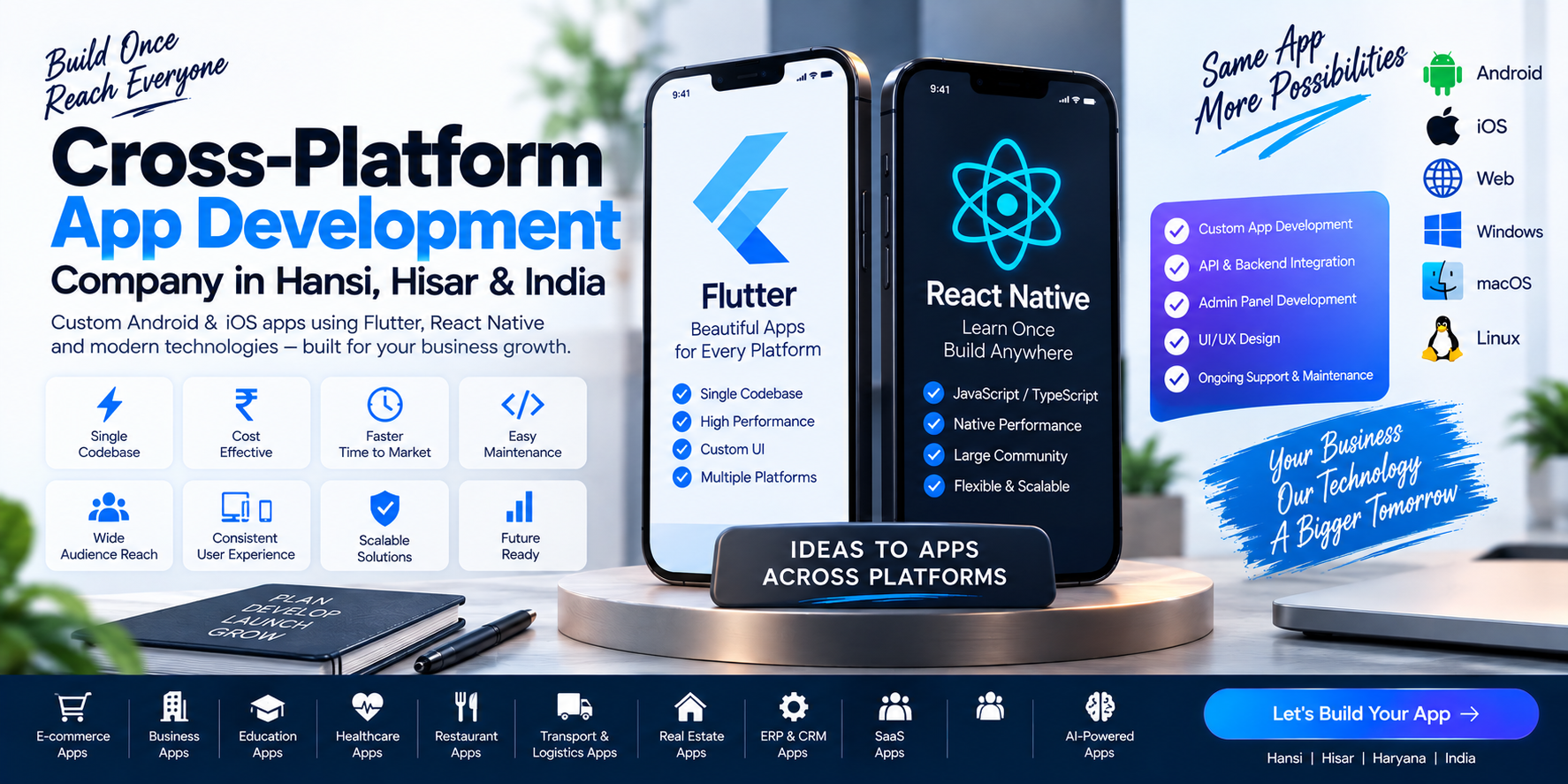
Cross-Platform App Development Company in Hansi, Hisar & India
Businesses today often need mobile applications that serve customers, employees, vendors, partners, and management teams across different devices.
Building separate applications for Android and iOS is one way to meet this requirement. Another approach is cross-platform app development, where developers use a shared codebase to build applications for multiple operating systems.
Frameworks such as Flutter and React Native support cross-platform development, but the best technical approach for a project depends on its features, integrations, user experience requirements, and long-term roadmap.
Cycode Technologies provides custom mobile application development services for businesses, startups, and organizations looking to build digital products and business applications.
Whether you need a customer-facing mobile app, an internal business application, an e-commerce platform, or a mobile interface connected to an existing ERP or SaaS product, your project can be planned around its specific requirements.
1. What Is Cross-Platform App Development?
Cross-platform app development is an approach to building applications that can run on more than one operating system using a shared codebase or development architecture.
For example, a business may want its application to be available to users on:
- Android smartphones
- iPhones
- Tablets
- Web browsers
- Desktop devices, where supported and appropriate
Frameworks such as Flutter and React Native provide ways to reuse application code across platforms while still allowing platform-specific implementation where needed.
A cross-platform project may include more than the mobile interface. Depending on the product, it can also require:
- Backend development
- Database design
- REST APIs
- Admin dashboard
- Authentication
- User roles and permissions
- Payment integration
- Notifications
- Cloud infrastructure
- Reporting and analytics
The objective is to build an application ecosystem that meets the business's functional and technical requirements.
2. Cross-Platform App Development Services at Cycode Technologies
Cycode Technologies develops custom applications according to the needs of each project.
Our cross-platform development services can include:
Custom Mobile Application Development
Applications designed around your business workflows, customers, and service requirements.
Android and iOS Applications
Mobile applications planned for Android and iOS using an appropriate development approach.
Flutter App Development
Flutter-based applications for supported platforms, with shared code and platform-specific integrations where required.
React Native App Development
React Native-based applications using React and JavaScript or TypeScript, with native integrations where required.
Business Application Development
Applications for employees, customers, vendors, field teams, and management.
E-commerce App Development
Shopping applications with product catalogues, customer accounts, orders, payments, and business integrations.
ERP and CRM Mobile Applications
Mobile interfaces connected to business management systems through suitable APIs.
SaaS Mobile Applications
Mobile applications connected to subscription-based software platforms.
Backend and API Development
Server-side functionality, databases, authentication, business logic, and integrations.
Admin Panel Development
Web-based administration systems for managing users, products, transactions, workflows, reports, and settings.
3. Flutter and React Native for Cross-Platform Development
Flutter and React Native are two frameworks businesses may evaluate when planning cross-platform mobile applications.
Flutter App Development
Flutter is an open-source framework that uses Dart and a widget-based approach to application interfaces. It supports building applications for Android, iOS, web, desktop, and other supported targets.
Flutter may be considered for projects that require:
- Android and iOS applications
- A shared application codebase
- Custom-branded interfaces
- Reusable UI components
- Integration with APIs and backend systems
- Multi-platform development
Some projects may also require platform-specific code or integrations, so those requirements should be assessed during planning.
React Native App Development
React Native uses React and JavaScript or TypeScript to build mobile applications.
It may be relevant for teams with existing React and JavaScript experience, particularly when that expertise can be reused in the mobile application project.
Projects may still require platform-specific implementation, testing, and native integrations depending on the required features.
How Do We Choose?
The framework should be selected after considering:
- Required platforms
- Application complexity
- Existing code and systems
- Team experience
- UI/UX requirements
- Third-party SDKs
- Device-specific features
- Testing and maintenance needs
For a detailed comparison, read our article:
Flutter vs React Native in 2026: Features, Performance, Cost & Business Use Cases
4. Benefits and Trade-Offs of Cross-Platform App Development
Cross-platform development can provide practical benefits, but it is not automatically the right fit for every project.
Shared Codebase
A shared codebase can reduce duplicated implementation work when developing for multiple platforms.
However, some features and interface behaviors may still need separate platform-specific code.
Coordinated Development
Sharing application logic and components can help teams coordinate features across platforms.
The extent of this benefit depends on the framework, project architecture, and the degree of platform-specific customization.
Consistent Product Experience
A shared design system and reusable components can help maintain consistency across platforms.
At the same time, the interface should account for platform conventions, accessibility, screen sizes, and user expectations.
Broader Platform Availability
Cross-platform frameworks can help businesses plan applications for multiple supported platforms.
Flutter, for example, documents support for Android, iOS, web, and desktop targets.
Important Trade-Offs
Cross-platform projects still need careful consideration of:
- Native SDK compatibility
- Device hardware requirements
- Background processing
- Performance-sensitive features
- Platform-specific design
- Testing across devices
- Framework and dependency maintenance
The development approach should be based on the product's actual requirements rather than assumptions about a framework.
5. Types of Cross-Platform Applications We Develop
Cycode Technologies can plan and develop cross-platform applications for different business models and industries.
Business Applications
Business apps can help employees and customers access services and information through mobile devices.
Possible features include:
- User login
- Dashboards
- Customer profiles
- Task management
- Notifications
- Reports
- API integration
- Admin controls
E-commerce Applications
An e-commerce application may include:
- Product catalogue
- Categories and filters
- Product variants
- Customer accounts
- Shopping cart
- Checkout
- Payment gateway
- Order history
- Delivery updates
- Reviews and ratings
- Wishlist
- Admin dashboard
For marketplace projects, additional functionality may be needed for sellers, commissions, payouts, inventory, and delivery partners.
ERP Mobile Applications
An ERP app can connect employees and business owners with their existing business management systems.
Potential modules include:
- Sales
- Purchases
- Inventory
- Accounting
- Customer management
- Supplier management
- Employee management
- Attendance
- Expenses
- Reports
- Approval workflows
The scope depends on the ERP's architecture and the APIs available for integration.
CRM Applications
A mobile CRM may include:
- Lead management
- Customer profiles
- Sales pipeline
- Follow-up reminders
- Tasks
- Calls and meeting records
- Sales reports
- Team management
- Notifications
SaaS Applications
A SaaS mobile app may be part of a larger software platform containing:
- Mobile application
- Web application
- Admin panel
- Subscription management
- Authentication
- Tenant or organization management
- Billing
- API services
- Database
- Analytics
A SaaS project should be scoped as a complete system rather than only a mobile interface.
Education Applications
Education apps may support:
- Students
- Parents
- Teachers
- School administrators
- Attendance
- Homework
- Learning materials
- Exams
- Results
- Fee information
- Notifications
- School ERP integration
Healthcare Applications
Healthcare app requirements may include:
- Patient registration
- Appointment booking
- Doctor profiles
- Medical information
- Prescriptions
- Reports
- Billing
- Patient communication
- Healthcare system integration
Privacy, security, and applicable regulatory requirements should be considered during planning.
Restaurant Applications
Restaurant apps may include:
- Digital menu
- QR menu
- Online ordering
- Table reservations
- Payments
- Order tracking
- Loyalty features
- Restaurant POS integration
- Kitchen workflows
Transport and Logistics Applications
Transport applications may require:
- Vehicle records
- Driver management
- Trip management
- GPS and maps
- Route information
- Freight or consignment records
- Fuel records
- Maintenance
- Delivery status
- Billing and reports
GPS and background location functionality should be assessed for the target platforms and required user permissions.
Real Estate Applications
Real estate apps may include:
- Property listings
- Search and filters
- Property details
- Images and videos
- Map-based discovery
- Lead forms
- Agent profiles
- Site visit requests
- CRM integration
- Notifications
6. Cross-Platform App Development Process
A structured development process helps clarify scope, dependencies, and deliverables.
Step 1: Requirement Analysis
We begin by understanding:
- Business objectives
- Target users
- Required platforms
- Core features
- User roles
- Existing systems
- Third-party integrations
- Security requirements
Step 2: Project Scope and Planning
The project scope can define:
- Features for the first release
- Future features
- Application platforms
- Backend requirements
- Admin panel requirements
- Integration responsibilities
- Testing requirements
- Delivery milestones
Step 3: UI/UX Design
The design process may include:
- User flows
- Wireframes
- Screen layouts
- Navigation
- Design system
- Responsive and adaptive behavior
- Interactive prototypes
The design should account for the differences between mobile platforms and device sizes.
Step 4: Technology and Architecture
The technical plan may define:
- Flutter, React Native, or another suitable approach
- Backend technology
- Database
- API structure
- Authentication
- Cloud infrastructure
- Third-party services
- Platform-specific components
Step 5: Application Development
Development may cover:
- Mobile frontend
- Backend services
- APIs
- Database
- Admin panel
- Integrations
- Notifications
- Business logic
Step 6: Testing and Quality Assurance
Testing can include:
- Functional testing
- API testing
- Device testing
- UI testing
- Performance testing
- Security checks
- Integration testing
- User acceptance testing
Step 7: Deployment
Deployment planning may cover:
- Production configuration
- App signing
- Store submission preparation
- Backend deployment
- Database setup
- Monitoring
- Release verification
Step 8: Maintenance and Improvements
After launch, the application may require:
- Bug fixes
- Dependency updates
- OS compatibility work
- Security updates
- API changes
- Performance improvements
- New features
- Infrastructure maintenance
7. Cross-Platform App Development Cost in India
The cost of a cross-platform application depends on the complete project scope.
Important cost factors include:
| Factor | How It Can Affect the Project |
|---|---|
| Number of platforms | More targets may require additional setup and testing. |
| Number of screens | More interfaces can increase design and implementation work. |
| Application complexity | Complex business logic requires additional development. |
| User roles | Separate user experiences may require additional workflows. |
| Backend development | APIs, databases, authentication, and business logic add scope. |
| Admin panel | Administration and reporting features require separate implementation. |
| Third-party integrations | SDKs, APIs, payments, maps, and messaging can add effort. |
| UI/UX requirements | Custom interactions and designs affect the work involved. |
| Security requirements | Sensitive workflows may require additional controls and testing. |
| Maintenance | Ongoing support and updates should be planned separately. |
A simple information app and a multi-user marketplace are both mobile applications, but their requirements can be substantially different.
For this reason, a meaningful quotation should specify the features, platforms, integrations, backend, testing, deployment, and support included in the project.
Related article: Mobile App Development Cost in India in 2026.
8. Cross-Platform App Development for Startups
Startups may need to validate a product idea while managing limited development resources and an evolving feature roadmap.
An MVP (Minimum Viable Product) can help a startup release its core functionality before expanding the application.
An initial version might include:
- Registration and login
- Core user workflow
- Basic dashboard
- Essential APIs
- Admin panel
- Basic analytics
Later releases may add:
- Advanced notifications
- Payments
- Additional user roles
- AI integrations
- Advanced reporting
- More platforms
- Automation
- Third-party integrations
The MVP scope should still account for security, data handling, and the technical foundations needed for future development.
9. Cross-Platform Apps Connected to Existing Business Software
Businesses may already have a website, ERP, CRM, accounting system, or SaaS platform.
A mobile app can sometimes be developed as an additional interface connected to those existing systems.
For example:
Existing ERP → API Layer → Mobile Application
This architecture may allow authorized users to access selected business functions through the app.
Before starting, the development team should assess:
- Whether APIs are available
- Authentication and permission rules
- Data structures
- Synchronization requirements
- Offline requirements
- Error handling
- Security
- Existing system limitations
The availability and quality of the existing integration interfaces can affect the project scope.
10. Security Considerations for Cross-Platform Applications
Security should be considered throughout the development process.
Depending on the application, the project may need:
- Secure authentication
- Role-based access control
- Encrypted network communication
- Secure handling of tokens and credentials
- Input validation
- API authorization
- Appropriate data storage
- Logging and monitoring
- Dependency maintenance
- Backup and recovery planning
Applications handling payments, healthcare information, personal data, or sensitive business records may require additional security and compliance analysis.
Security requirements should be defined according to the application's purpose, users, data, and applicable laws.
11. Why Choose Cycode Technologies?
Cycode Technologies develops custom software and mobile applications for businesses and organizations.
Our development capabilities include:
- Cross-platform mobile applications
- Android app development
- iOS app development
- Flutter app development
- Custom software development
- ERP and CRM applications
- SaaS platforms
- E-commerce applications
- AI-enabled software
- Backend and API development
- Admin panel development
- Cloud application integration
We can work with businesses to define their application requirements, plan the technology architecture, develop the required interfaces and integrations, and establish a suitable maintenance scope.
12. Cross-Platform App Development in Hansi, Hisar, Haryana & India
If you are searching for a cross-platform app development company in Hansi, Hisar, or Haryana, Cycode Technologies offers custom application development services for businesses and organizations.
We can help plan applications for:
- Retail and e-commerce
- Education
- Healthcare
- Restaurants
- Transport and logistics
- Real estate
- Business management
- SaaS products
- Startups
- Enterprise workflows
Projects can be planned for clients in Hansi, Hisar, across Haryana, and throughout India.
Frequently Asked Questions
What is cross-platform app development?
Cross-platform app development is an approach to building applications for multiple operating systems using a shared codebase or development architecture. Frameworks such as Flutter and React Native support this approach.
What is the difference between cross-platform and native app development?
Cross-platform development focuses on sharing code across platforms. Native development uses platform-specific technologies and frameworks. The appropriate approach depends on the application's requirements, integrations, user experience, and team capabilities.
Which frameworks are used for cross-platform app development?
Flutter and React Native are two frameworks used for cross-platform application development. The selection should consider project requirements, developer experience, platform needs, and available integrations.
Can cross-platform apps run on Android and iOS?
Yes. Frameworks such as Flutter and React Native support development for Android and iOS. Specific platform requirements may still need separate implementation and testing.
Can a cross-platform app connect to an existing ERP?
Yes, when the ERP provides suitable APIs or integration interfaces. The project must account for authentication, permissions, data structures, and synchronization.
Can cross-platform applications include payment gateways?
Payment gateways can be integrated when the selected provider supports the required platforms and the application meets its technical and compliance requirements.
Can cross-platform apps use GPS and maps?
Applications can use location and mapping functionality when supported by the selected framework, platform APIs, libraries, and permissions. Requirements such as background location need specific evaluation.
Is cross-platform development suitable for startups?
It can be considered for startups that need applications across multiple platforms. The decision should account for the product requirements, team skills, integrations, and future roadmap.
How much does cross-platform app development cost in India?
The cost depends on platforms, features, user roles, backend, admin panel, integrations, design, testing, and maintenance. A defined project scope is needed for a meaningful estimate.
How long does cross-platform app development take?
The timeline depends on complexity, design, backend requirements, integrations, testing, and release planning. A project schedule should be prepared after requirements are reviewed.
Do cross-platform apps need maintenance?
Yes. They may require bug fixes, framework and dependency updates, operating-system compatibility work, security improvements, API changes, and new features.
Does Cycode Technologies develop custom mobile applications?
Cycode Technologies provides custom mobile application development services, including Android, iOS, Flutter, cross-platform, backend, and API development.
Conclusion
Cross-platform app development gives businesses an approach for building applications across multiple platforms while sharing parts of the codebase and development process.
Frameworks such as Flutter and React Native offer different programming models, UI approaches, and integration options. The appropriate choice depends on the application rather than a universal claim that one framework suits every project.
Before beginning development, define:
- Required platforms
- Core features
- User roles
- UI/UX expectations
- Backend and API requirements
- Third-party integrations
- Security requirements
- Testing and deployment scope
- Maintenance and future roadmap
Cycode Technologies provides custom mobile application development services for businesses in Hansi, Hisar, Haryana, and across India.