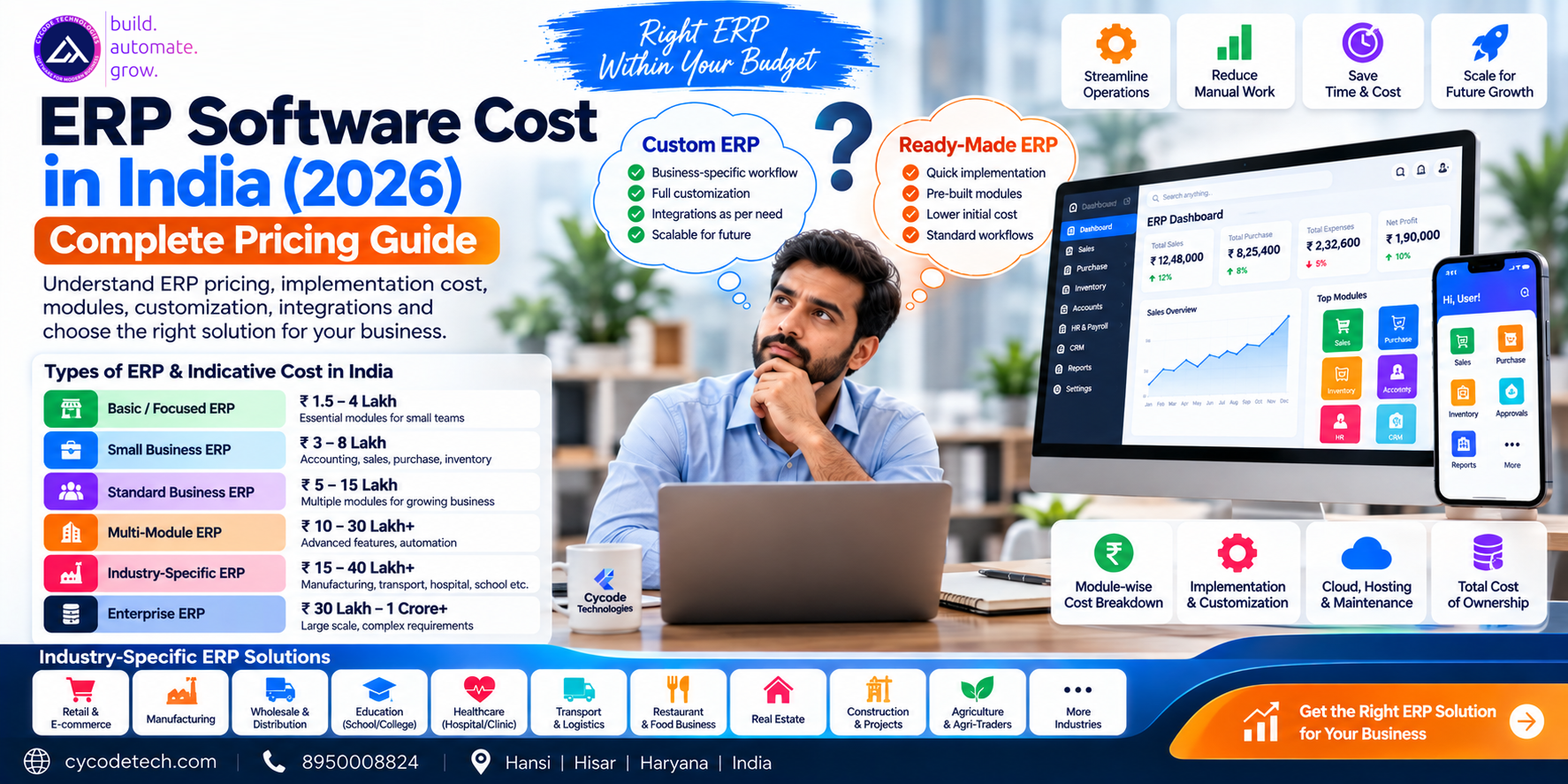
ERP Software Cost in India (2026): Complete Pricing Guide
If your business is considering an ERP system, one of the first questions is usually:
“How much does ERP software cost?”
There isn't one universal ERP price.
A small business requiring accounting, sales, purchase and inventory may need a very different solution from a manufacturer requiring production, procurement, warehouse management, quality control, HR, payroll, multiple branches and mobile applications.
ERP systems are designed to connect business processes and shared data across functions such as finance, procurement, supply chain, HR, manufacturing and project management.
The total cost therefore depends not only on the software itself, but also on implementation, configuration, customization, integrations, migration, training, hosting, support and ongoing maintenance.
This guide explains the major ERP pricing models in India and the factors you should consider before setting an ERP budget.
1. How Much Does ERP Software Cost in India?
For early budgeting, ERP projects can broadly fall into these ranges:
| ERP Type | Indicative Budget |
|---|---|
| Basic / Focused ERP | ₹1.5 lakh – ₹4 lakh |
| Small Business ERP | ₹3 lakh – ₹8 lakh |
| Standard Business ERP | ₹5 lakh – ₹15 lakh |
| Multi-Module ERP | ₹10 lakh – ₹30 lakh+ |
| Industry-Specific ERP | ₹15 lakh – ₹40 lakh+ |
| Complex / Enterprise ERP | ₹30 lakh – ₹1 crore+ |
These are indicative planning ranges, not fixed Indian market prices or quotations.
The actual cost can be substantially lower or higher depending on:
- Number of modules
- Number of users
- Business complexity
- Customization
- Mobile applications
- Integrations
- Data migration
- Reports
- Automation
- Hosting
- Security
- Training
- Support
A SaaS ERP subscription and a completely custom ERP should also not be compared using only their initial price.
2. Why ERP Prices Vary So Much
Consider two businesses.
Business A
A small distributor needs:
- Sales
- Purchase
- Inventory
- Accounting
- Basic reports
An existing ERP or focused business ERP may be sufficient.
Business B
A larger manufacturer needs:
- CRM
- Sales
- Purchase
- Inventory
- Multi-warehouse
- Production
- BOM
- Quality
- HR
- Payroll
- Accounting
- Multiple branches
- Mobile applications
- Dealer portal
- Custom reports
- API integrations
These two projects should obviously not have the same budget.
The scope of the ERP is one of the biggest factors determining its cost.
3. ERP Pricing Models
ERP software can be delivered through several commercial models.
Model 1: Subscription-Based ERP
The business pays a recurring subscription.
For example:
- ₹X per user/month
- ₹X per user/year
The exact pricing varies by provider.
Potential benefits include:
- Lower initial software expenditure
- Vendor-managed product updates
- Cloud access
- Predictable recurring pricing
However, businesses should evaluate the total cost over several years, including users, modules, integrations and additional services.
Model 2: One-Time ERP License
Some ERP products may use a licensing model where the business pays an upfront software license.
Additional costs may include:
- Implementation
- Customization
- Support
- Hosting
- Updates
- Integration
- Training
The commercial model depends on the vendor.
Model 3: Custom ERP Development
With custom ERP development, the software is developed specifically around the organization's requirements.
The cost can include:
- Business analysis
- UI/UX
- Backend
- Database
- ERP modules
- APIs
- Admin panel
- Mobile applications
- Integrations
- Testing
- Deployment
- Documentation
- Support
Custom ERP generally requires a larger initial development effort because the software is being designed and built around the specific requirements.
Read also: Custom ERP vs Ready-Made ERP
4. ERP Cost by Business Size
Small Business ERP
A small company may only need:
- Accounting
- Sales
- Purchase
- Inventory
- Customers
- Suppliers
- Basic reports
A focused ERP can potentially be implemented without the complexity of a large enterprise system.
Indicative budget: ₹3 lakh – ₹8 lakh
Medium Business ERP
A growing organization may require:
- Finance
- Sales
- Purchase
- Inventory
- CRM
- HR
- Payroll
- Multi-location
- Reports
- Automation
Indicative budget: ₹8 lakh – ₹20 lakh+
Large / Enterprise ERP
A larger organization may require:
- Multiple branches
- Multiple warehouses
- Manufacturing
- Supply chain
- Advanced finance
- HR
- CRM
- Field operations
- Mobile apps
- External integrations
- Business intelligence
- Complex permissions
Indicative budget: ₹20 lakh – ₹1 crore+
For large ERP transformations, the implementation and operational scope can become much larger than the software license itself.
5. ERP Cost by Number of Modules
The number and complexity of modules can significantly affect the budget.
Basic ERP
- Accounting
- Sales
- Purchase
- Inventory
Standard ERP
- Accounting
- Sales
- Purchase
- Inventory
- CRM
- HR
- Payroll
Advanced ERP
- Accounting
- Sales
- Purchase
- Inventory
- CRM
- HR
- Payroll
- Manufacturing
- Projects
- Field force
- Logistics
- Advanced analytics
6. ERP Development Cost by Module
Accounting & Finance
Possible features:
- Ledger
- Chart of accounts
- Invoices
- Receivables
- Payables
- Expenses
- Bank reconciliation
- Financial reports
- Tax-related workflows
Accounting is generally a core component of ERP because financial transactions need to connect with other business processes.
Sales Module
Potential features:
- Leads
- Customers
- Quotations
- Orders
- Invoices
- Payments
- Salesperson management
- Follow-ups
- Sales reports
Purchase Module
Potential features:
- Suppliers
- Purchase requests
- Purchase orders
- Goods receipt
- Purchase invoices
- Supplier payments
- Purchase reports
Inventory Module
Potential features:
- Products
- Warehouses
- Stock
- Stock transfers
- Adjustments
- Batch tracking
- Serial numbers
- Inventory reports
HR & Payroll
Potential functionality:
- Employee profiles
- Attendance
- Leave
- Payroll
- Salary structures
- Employee documents
- Loans/advances
- HR reports
CRM
Potential functionality:
- Leads
- Opportunities
- Sales pipeline
- Follow-ups
- Tasks
- Customer history
- Communication
- Sales analytics
Manufacturing
A manufacturing ERP may require:
- Bill of Materials
- Production planning
- Work orders
- Raw materials
- Material consumption
- Quality control
- Finished goods
- Production reports
7. How Much Does Custom ERP Development Cost?
For a custom ERP, an indicative planning structure might look like this:
| Custom ERP Scope | Indicative Development Budget |
|---|---|
| 2–3 core modules | ₹3–6 lakh |
| 4–6 modules | ₹6–12 lakh |
| 7–10 modules | ₹10–20 lakh |
| 10+ modules | ₹15–30 lakh+ |
| Complex industry ERP | ₹25–50 lakh+ |
| Enterprise platform | Scope dependent |
These figures are budgeting examples rather than standard market rates.
A six-module ERP with simple workflows can cost less than a three-module ERP containing highly complex manufacturing, accounting and integration requirements.
8. Customization and Its Effect on ERP Cost
Customization can significantly change an ERP budget.
For example, an existing ERP may already have:
Sales → Invoice → Payment
But your company may require:
Sales → Credit Approval → Special Pricing → Manager Approval → Warehouse Allocation → Delivery → Invoice → Commission → Collection
Additional business logic means additional analysis, development and testing.
This is why businesses should estimate customization based on actual workflows, not simply the number of screens.
9. ERP Integration Cost
Modern ERP systems often need to connect with other software.
Possible integrations include:
- Payment gateways
- Banking
- Accounting systems
- E-commerce
- SMS
- GPS
- Biometric devices
- CRM
- Shipping
- Government or third-party APIs
For example:
E-Commerce
     ↓
    API
     ↓
    ERP
   ↙   ↘
Stock   Accounting
Every integration may require:
- API authentication
- Data mapping
- Error handling
- Testing
- Monitoring
- Ongoing maintenance
Therefore, integration requirements should be included in the ERP budget from the beginning.
10. ERP Mobile App Development Cost
A business may want mobile access for:
- Management
- Salespeople
- Employees
- Drivers
- Customers
- Vendors
A mobile application adds development and testing requirements.
Sales App
- Customer list
- Product catalogue
- Orders
- Collections
- Visits
Management App
- Dashboard
- Approvals
- Reports
- Notifications
Driver App
- Trips
- Routes
- Delivery
- Status updates
If Android and iOS applications are required, the project should also consider the chosen technology and platform-specific requirements.
11. ERP Admin Panel Cost
A custom ERP normally requires an administration interface.
The admin panel may manage:
- Users
- Permissions
- Modules
- Branches
- Products
- Customers
- Suppliers
- Reports
- Settings
- Integrations
A simple ERP dashboard may be relatively small.
An enterprise ERP administration system can contain many workflows and configuration screens.
The admin panel should therefore be included in the project scope rather than treated as a minor add-on.
12. ERP Cloud Hosting Cost
Cloud ERP introduces ongoing infrastructure costs.
Depending on the architecture, these can include:
- Application server
- Database
- Storage
- CDN
- Backups
- Monitoring
- Email services
- File storage
- Security services
The monthly cost depends on:
- Number of users
- Database size
- Traffic
- File storage
- Application architecture
- Backup requirements
- Availability requirements
Cloud hosting should therefore be considered separately from development cost.
13. ERP Data Migration Cost
If a business already has data, moving it into a new ERP can require additional work.
Data may come from:
- Excel
- Existing ERP
- Accounting software
- CSV
- Legacy databases
Migration can involve:
Extract → Clean → Transform → Map → Import → Validate
For example:
Old Customer Data
       ↓
Data Cleaning
       ↓
Field Mapping
       ↓
Import
       ↓
Validation
       ↓
New ERP
Data quality, transformation, testing and validation are important factors in data-transition work.
14. ERP Training Cost
Employees need to understand how to use the new system.
Training may be required for:
- Administrators
- Accountants
- Sales teams
- Purchase teams
- Warehouse employees
- HR
- Managers
- Management
Training can include:
- Documentation
- Videos
- Live sessions
- User manuals
- Role-specific training
Training should be included in the implementation plan, particularly for large ERP projects.
15. ERP Testing Cost
Testing becomes particularly important when several modules are connected.
For example:
Sales
  ↓
Inventory
  ↓
Invoice
  ↓
Accounting
A change in one module can affect another.
Testing may include:
- Functional testing
- Integration testing
- API testing
- Permission testing
- Financial testing
- Device testing
- Performance testing
- User acceptance testing
- Regression testing
Reducing testing effort simply to reduce the initial budget can create additional operational problems later.
16. ERP Maintenance Cost
ERP software continues to require technical attention after launch.
Maintenance may include:
- Bug fixes
- Security updates
- Server maintenance
- Database maintenance
- API changes
- Backup monitoring
- Performance optimization
- New reports
- New features
- Compatibility updates
Recurring ERP costs should therefore be included in the long-term budget.
17. ERP Implementation Cost vs ERP Software Cost
These two costs are not always the same.
Software Cost
May include:
- License
- Subscription
- User fees
- Module fees
Implementation Cost
May include:
- Consulting
- Configuration
- Customization
- Data migration
- Testing
- Training
- Deployment
For a custom ERP:
Software development itself becomes a major part of the project cost.
This distinction is important when comparing ERP quotations.
18. Total Cost of Ownership of ERP
The initial ERP quotation isn't necessarily the total amount you will spend.
A more useful model is:
Total Cost of Ownership
Software + Implementation + Customization + Integration + Migration + Training + Hosting + Support + Maintenance + Future Enhancements
This is why two ERP proposals with similar initial prices can have very different long-term costs.
19. How to Reduce ERP Development Cost
Reducing ERP cost does not necessarily mean removing important functionality.
A better approach is to control scope.
Start With Core Modules
For example:
Phase 1
- Accounting
- Sales
- Purchase
- Inventory
Phase 2
- CRM
- HR
- Payroll
Phase 3
- Mobile app
- Advanced analytics
- Automation
- External integrations
20. Use Existing Software Where It Makes Sense
A business doesn't always need a completely custom ERP.
If an existing product already handles:
- Accounting
- Inventory
- Sales
- Purchase
there may be no reason to rebuild those functions.
Instead, custom development can focus on the missing requirements.
For example:
Existing ERP
      +
Custom CRM
      +
Mobile App
      +
API Integration
This hybrid approach can sometimes provide a practical balance between standardization and customization.
21. How to Choose an ERP Based on Budget
Budget: Smaller
Consider:
- Existing ERP
- SaaS ERP
- Focused modules
- Limited customization
Medium Budget
Consider:
- Configurable ERP
- Custom integrations
- Selected custom modules
- Mobile application
Larger Budget
Consider:
- Custom ERP
- Multi-branch architecture
- Advanced automation
- Custom mobile apps
- Industry-specific modules
- Advanced analytics
Budget alone should not determine the architecture. The business requirements should come first, followed by a realistic evaluation of available options.
22. ERP Software Cost for Different Industries
Retail ERP
Potential modules:
- POS
- Inventory
- Purchase
- Sales
- Customer management
- Accounting
Manufacturing ERP
Potential modules:
- Production
- BOM
- Inventory
- Purchase
- Quality
- Sales
- Accounting
Wholesale ERP
Potential modules:
- Sales
- Purchase
- Inventory
- Customer credit
- Sales representatives
- Accounting
Transport ERP
Potential modules:
- Vehicles
- Drivers
- Trips
- Fuel
- Maintenance
- Expenses
- Billing
School ERP
Potential modules:
- Students
- Parents
- Staff
- Fees
- Attendance
- Exams
- Transport
- Communication
Hospital ERP
Potential modules:
- Patients
- Doctors
- Appointments
- Billing
- Pharmacy
- Inventory
- Reports
The module requirements can significantly change the project scope and therefore the cost.
23. ERP Software Cost in Hansi, Hisar & Haryana
Businesses searching for ERP software in Hansi, Hisar, Haryana or India may have very different requirements.
A local retailer may need:
POS + Inventory + Accounting
A distributor may require:
Sales + Purchase + Inventory + Field Sales + Accounting
A manufacturer may need:
Production + BOM + Inventory + Purchase + Sales + Accounting
A school may require:
Student + Fees + Attendance + Examination + Transport
Cycode Technologies develops ERP and business software and also offers specialized platforms for areas such as education, accounting, transport, restaurants, healthcare and general business management.
24. Cycode Technologies ERP & Business Software
Cycode Technologies can approach ERP requirements in two ways.
Existing Product
Where an existing SaaS platform already matches the business requirements.
Its software ecosystem includes:
- EduMittar — school ERP
- AccuBook — accounting/business finance
- FleetLogic — transport management
- KwikDine — restaurant POS
- PulsePanel — hospital/clinic management
- Vendly — business/accounting/inventory
- CyFlo — business SaaS/reseller platform
Custom ERP Development
Where the business requires:
- Unique workflows
- Custom modules
- Special reports
- Custom integrations
- Industry-specific processes
- Custom mobile applications
- Specialized automation
This lets the project start from an existing platform where appropriate or move into custom development where the requirements justify it.
25. Questions to Ask Before Buying ERP Software
Before choosing an ERP, ask:
- What is the total software cost?
- Is pricing per user?
- Are there additional module charges?
- Is implementation included?
- Is data migration included?
- Is customization included?
- What integrations are supported?
- Is a mobile application included?
- Is hosting included?
- What support is included?
- What happens when the business grows?
- How are future upgrades handled?
- Who owns the data?
- Can data be exported?
- What happens if we leave the platform?
These questions can reveal costs that are not visible in the initial quotation.
26. Questions to Ask a Custom ERP Development Company
If you are considering custom ERP development, ask:
What exactly will be developed?
Request a module-wise scope.
Is UI/UX included?
Clarify the design deliverables.
Is backend development included?
An ERP requires more than frontend screens.
Is API development included?
Important for mobile and third-party integrations.
Is testing included?
Define the testing scope.
Is deployment included?
Clarify hosting and production deployment.
Who owns the source code?
This should be clearly specified in the contract.
What support is included?
Ask about the duration and scope of post-launch support.
How are future changes charged?
Define the process for additional features.
27. Frequently Asked Questions
How much does ERP software cost in India?
A focused ERP may start from a few lakh rupees, while multi-module custom or enterprise ERP projects can cost tens of lakhs or more. The actual budget depends on modules, users, customization, integrations, migration, hosting and support.
What is the average ERP cost for a small business?
A small-business ERP may fall around ₹3–8 lakh as an initial planning range for a focused implementation, although SaaS products can have very different subscription models and custom projects can vary significantly.
How much does custom ERP development cost?
A custom ERP can range from several lakh rupees for a focused system to tens of lakhs or more for a complex multi-module platform. Requirements should be assessed before quoting.
Is ERP software available on monthly subscription?
Yes. Many ERP products use subscription-based pricing, although the exact model varies by provider.
Is cloud ERP cheaper than custom ERP?
They are not directly comparable. Cloud ERP describes a deployment model, while custom ERP describes how the software is developed. A custom ERP can also be deployed in the cloud.
Does ERP cost include hosting?
Not always. Hosting may be included in some SaaS plans but charged separately for other ERP solutions.
Does ERP cost include maintenance?
It depends on the agreement. Some products include certain support or updates, while custom ERP projects usually have separate maintenance arrangements.
Does ERP include a mobile application?
Not necessarily. Mobile functionality should be specifically included in the product or project scope.
Can ERP integrate with existing accounting software?
Potentially, if the accounting system provides suitable APIs or integration mechanisms.
Can I start with a few ERP modules?
Yes. A phased implementation can begin with the most important modules and expand later.
What is the biggest ERP cost factor?
There is no single factor for every project. Scope, customization, integrations, users, data migration, implementation and ongoing support can all materially affect total cost.
28. Final Thoughts
The question “How much does ERP software cost in India?” cannot be answered responsibly with one fixed number.
The better approach is to calculate:
Software + Implementation + Customization + Integration + Migration + Training + Hosting + Maintenance
Then compare that total against the business value and operational requirements.
For some businesses, an existing SaaS ERP may be the practical route.
For others, a configurable ERP with custom extensions may make more sense.
And for organizations with highly specialized workflows, custom ERP development may be worth evaluating.
The important thing is to define the business process first and select the software approach second.
If you're looking for ERP software, custom ERP development or business software in Hansi, Hisar, Haryana or across India, Cycode Technologies can evaluate your requirements and help determine whether an existing platform or a custom solution is appropriate.