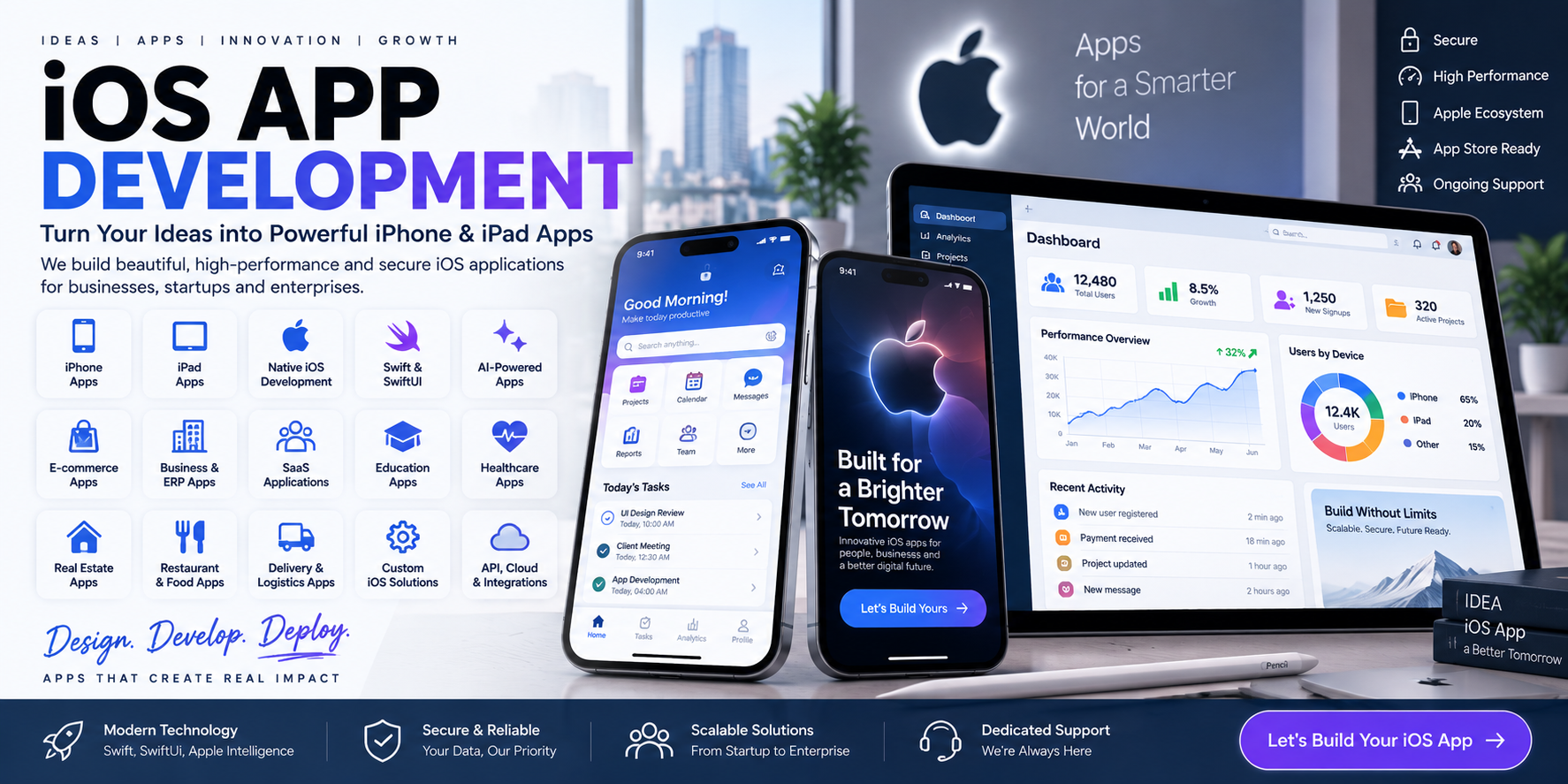
iOS App Development Company in Hansi, Hisar & India
Custom iPhone, iPad & Apple Platform Applications for Businesses, Startups and Enterprises
The mobile application market is no longer limited to Android.
For businesses targeting customers who use iPhone, iPad and other Apple devices, an iOS application can become an important part of their digital strategy.
An iOS application can be used for:
- E-commerce
- Banking and finance
- Healthcare
- Education
- Real estate
- Food delivery
- Logistics
- Travel
- Booking
- SaaS
- CRM
- ERP
- Business management
- AI-powered products
- Entertainment
- Memberships
- Subscription services
- Enterprise applications
Cycode Technologies is an iOS app development company serving Hansi, Hisar, Haryana and businesses across India, developing custom iPhone and iPad applications connected with websites, cloud backends, APIs, ERP, CRM, SaaS platforms and other business systems.
Whether you have a startup idea, an existing Android application that needs an iOS version, or a complete business software requirement, the application can be planned around your users and business objectives.
What Is iOS App Development?
iOS app development is the process of designing, developing, testing, deploying and maintaining applications for Apple's platforms.
Depending on the project, an application can target:
- iPhone
- iPad
- Apple Watch
- Apple TV
- Mac
- Apple Vision Pro
- Other Apple platform experiences
Apple's current development ecosystem provides tools and frameworks for building apps across these platforms, with Swift, SwiftUI, App Intents, WidgetKit and other platform technologies playing important roles.
For a typical business application, however, the main requirement may simply be:
iPhone App + Backend + Database + Admin Panel + API
The architecture can then be expanded as the product grows.
Why Does a Business Need an iPhone App?
A website allows customers to access a business through a browser.
An application can provide a more dedicated experience.
An iOS app can help businesses provide:
Direct Customer Access
Customers can access products, services, bookings, orders and accounts directly through their phones.
Push Notifications
Businesses can communicate important information about:
- Orders
- Payments
- Appointments
- Offers
- Bookings
- Deliveries
- Account activity
Personalized Experience
The app can remember relevant preferences and provide customized experiences.
Mobile Commerce
Customers can browse products, place orders and make payments.
Customer Loyalty
Businesses can build:
- Memberships
- Rewards
- Loyalty programs
- Subscription plans
- Referral systems
Business Operations
Employees can use iOS applications for:
- Sales
- Field work
- Customer management
- Tasks
- Attendance
- Reports
- Business operations
Custom iOS App Development
Not every business requires the same application.
A restaurant may need ordering and delivery.
A hospital may need appointments and patient services.
A real estate company may need property search and enquiries.
A SaaS company may need dashboards and subscriptions.
A manufacturer may need ERP access.
Custom iOS development allows the product to be designed around the actual business workflow.
Possible functionality includes:
- Registration
- Login
- OTP
- User profiles
- Product catalogs
- Search
- Filters
- Orders
- Booking
- Payments
- Subscriptions
- Notifications
- GPS
- Maps
- Chat
- Documents
- Reports
- Dashboards
- CRM
- ERP
- AI
- Analytics
- Customer support
- API integrations
iPhone App Development Services
Cycode Technologies can develop different types of iOS applications depending on the requirement.
Native iOS App Development
Native iOS applications can be built specifically for Apple's ecosystem using Apple's native development technologies.
Native development can be appropriate when the application requires:
- Deep Apple platform integration
- High performance
- Advanced device capabilities
- Platform-specific functionality
- Complex animations
- Specialized hardware features
Swift App Development
Swift is Apple's programming language for modern application development.
It is designed for building software across Apple's platforms.
For businesses looking for native iOS applications, Swift can be used to build:
- Business applications
- E-commerce apps
- SaaS apps
- Enterprise applications
- Healthcare applications
- Education applications
- AI applications
- Utility applications
- Consumer applications
SwiftUI App Development
SwiftUI is Apple's modern UI framework for building interfaces across Apple platforms.
Apple continues to expand SwiftUI's capabilities, including improvements to performance, navigation, layouts, interactions and cross-platform development.
SwiftUI can be useful for building modern application interfaces with:
- Reusable components
- Responsive layouts
- Modern navigation
- Lists
- Forms
- Animations
- Accessibility
- Adaptive interfaces
The appropriate choice between SwiftUI and UIKit depends on the application, existing codebase and technical requirements.
iPhone & iPad App Development
A business may need more than an iPhone application.
For example, a field employee may use an iPhone while management uses an iPad dashboard.
Applications can therefore be designed for different screen sizes and workflows.
Examples:
iPhone
Customer-facing mobile application.
iPad
Larger interface for:
- Managers
- Doctors
- Teachers
- Sales teams
- Restaurant managers
- Business administrators
This creates a broader Apple-device experience rather than treating the iPhone as the only target.
iOS E-Commerce App Development
An online store can have a dedicated iOS shopping application.
Features can include:
- Product catalog
- Categories
- Search
- Filters
- Product details
- Wishlist
- Cart
- Checkout
- Online payments
- Coupons
- Orders
- Delivery tracking
- Customer accounts
- Notifications
- Reviews
- Loyalty
- Offers
The app can connect to an existing e-commerce website and backend.
This means the business can operate:
Website + iPhone App + Android App + Admin Panel + Inventory
using a shared backend.
iOS Business App Development
Businesses can create applications for customers, employees, salespeople or management.
Examples include:
- Business management apps
- Customer apps
- Employee apps
- Sales apps
- Field-force apps
- CRM apps
- Accounting apps
- Inventory apps
- Booking apps
- Service management apps
- Reporting apps
An employee application can allow field workers to update information directly from their phones.
iOS ERP App Development
ERP systems traditionally operate through desktop or web interfaces.
Mobile ERP applications can provide selected ERP functionality on the go.
An iOS ERP application can provide:
- Sales
- Purchases
- Inventory
- Customers
- Suppliers
- Accounting
- Expenses
- Employees
- Attendance
- Payments
- Reports
- Dashboards
- Approvals
For example, a business owner travelling outside the office can still access important business information.
iOS CRM App Development
A CRM application can help sales teams manage customers and leads from mobile devices.
Features can include:
- Lead management
- Customer management
- Enquiries
- Follow-ups
- Tasks
- Appointments
- Sales pipeline
- Notes
- Calls
- Notifications
- Reports
A salesperson can update a lead immediately after a customer meeting rather than waiting until they return to the office.
iOS SaaS App Development
If a company operates a SaaS platform, an iOS application can provide customers with mobile access.
A SaaS application can include:
- User accounts
- Subscription plans
- Dashboard
- Notifications
- Billing
- Reports
- User roles
- API integration
- Cloud data
- Account management
For example:
SaaS Website
iOS App
Android App
Web Dashboard
can all communicate with the same cloud backend.
AI-Powered iOS App Development
AI is becoming an important part of modern Apple applications.
Apple's current developer platform includes the Foundation Models framework, which provides APIs for integrating language-model capabilities, including multimodal experiences and on-device intelligence. Apple also provides Core AI for on-device AI workloads.
This creates opportunities for applications such as:
AI Assistants
Users can interact with an intelligent assistant inside the application.
AI Search
Users can search information using natural-language queries.
Document Intelligence
Applications can analyze documents, images or text.
AI Recommendations
Apps can provide personalized recommendations.
AI Business Tools
AI can help summarize information, generate reports or assist with business workflows.
AI Customer Support
Businesses can provide automated assistance through an app.
On-Device AI
Some AI functionality can run directly on supported Apple devices, which can provide benefits around responsiveness, privacy and reduced server dependency depending on the use case.
iOS Apps & Apple Intelligence
Apple's current platform also provides ways for applications to connect their content and actions with Apple Intelligence and Siri through App Intents.
This allows supported app functionality to become discoverable through natural-language interactions.
For example, depending on the app and implementation, users could interact with supported application actions through system-level experiences rather than opening the app and navigating manually.
This opens new possibilities for:
- Business actions
- Search
- Shortcuts
- Automation
- Productivity
- Personal assistants
- App-specific workflows
iOS Healthcare App Development
Healthcare applications can provide:
- Patient registration
- Doctor profiles
- Appointment booking
- Medical information
- Prescriptions
- Reports
- Notifications
- Teleconsultation integrations
- Billing
- Pharmacy
- Patient communication
An iOS healthcare app can also connect to a hospital or clinic management backend.
Related: PulsePanel Hospital & Clinic Management System
iOS Education App Development
Education applications can provide:
- Student login
- Parent login
- Classes
- Attendance
- Homework
- Exams
- Results
- Fees
- Study material
- Notifications
- Teacher communication
- Online learning
An iOS education application can connect with a complete school or coaching ERP.
Related: EduMittar School Management ERP
iOS Real Estate App Development
Real estate businesses can use iPhone applications for property discovery and lead management.
Features can include:
- Property listings
- Property search
- Filters
- Property images
- Videos
- Location
- Buyer enquiries
- Seller enquiries
- Agent profiles
- Site visits
- Booking
- Payments
- Notifications
- Saved properties
Internal agent applications can also include:
- Leads
- Follow-ups
- Site visits
- Customer management
- Property inventory
- Booking status
Related: Real Estate & Property Management ERP
iOS Restaurant App Development
Restaurants can develop applications for:
- Online ordering
- Food delivery
- Table booking
- Digital menus
- Offers
- Loyalty
- Customer accounts
- Order tracking
- Notifications
The app can connect with restaurant POS and kitchen systems.
Related: KwikDine Restaurant POS & QR Menu
iOS Transport & Delivery App Development
Transport and logistics businesses can use iOS applications for:
- Drivers
- Customers
- Trips
- Deliveries
- GPS
- Tracking
- Documents
- Expenses
- Notifications
- Delivery status
Different apps can be developed for:
Driver + Customer + Admin
with all applications connected to the same backend.
Related: FleetLogic Transport Management Software
iOS Accounting & Business Management App
Businesses can access financial and operational information from their iPhone.
Possible functionality includes:
- Sales
- Invoices
- GST billing
- Expenses
- Customers
- Suppliers
- Payments
- Outstanding balances
- Inventory
- Reports
For businesses already using an accounting or ERP platform, the iOS app can act as a mobile interface to the existing system.
Related: AccuBook & Vendly
iOS Employee Management App
An employee application can include:
- Attendance
- Leave
- Tasks
- Employee profile
- Documents
- Expenses
- Field visits
- Location
- Notifications
- Internal communication
This can be especially useful for companies with employees working outside the office.
iOS Booking App Development
Booking applications can be developed for:
- Hotels
- Restaurants
- Clinics
- Salons
- Consultants
- Events
- Travel
- Rentals
- Classes
- Appointments
- Professional services
A booking system can include:
Search → Availability → Booking → Payment → Confirmation → Notification
iOS Delivery App Development
A delivery ecosystem can contain multiple applications.
Customer App
Place and track orders.
Delivery Partner App
Receive assigned deliveries and update delivery status.
Admin Panel
Manage orders, delivery partners, customers and reports.
Backend
Connect everything together.
iOS App Backend & API Development
A mobile application needs reliable backend infrastructure when it stores or exchanges business data.
The backend can handle:
- Authentication
- User accounts
- Database
- APIs
- Business logic
- Payments
- Notifications
- Files
- Reports
- Integrations
- Security
The same backend can potentially serve:
iOS + Android + Website + Admin Panel + ERP
This is often more efficient than building completely separate business systems for every platform.
iOS App Admin Panel
A web-based administration panel can control the application.
Administrators can manage:
- Users
- Products
- Orders
- Bookings
- Payments
- Content
- Notifications
- Categories
- Reports
- Employees
- Customers
- App settings
The admin panel can be connected to the same backend as the iOS application.
iOS App UI/UX Design
A professional iPhone application should be designed around Apple's platform conventions while maintaining the company's brand identity.
Important areas include:
- Simple navigation
- Clear hierarchy
- Touch-friendly controls
- Responsive layouts
- Accessibility
- Readable typography
- Consistent interactions
- Fast feedback
- Appropriate animations
- Error handling
- Loading states
- Dark mode where appropriate
Apple's 2026 platform guidance continues to emphasize adaptive interfaces, refined navigation and SwiftUI-based experiences across its platforms.
iOS App Security & Privacy
Security is particularly important when applications handle:
- Customer information
- Financial information
- Healthcare information
- Business data
- Authentication credentials
- Documents
- Payments
Depending on the project, security architecture can include:
- Secure authentication
- Role-based access
- Encrypted communication
- Secure API architecture
- Input validation
- Session management
- Secure storage
- Access controls
- Payment security
- Logging
- Monitoring
Apple also provides platform security technologies and development tools intended to help developers protect applications and user data.
iOS App Development Process
1. Requirement Analysis
First understand:
- Business
- Target users
- Problem
- Features
- Competitors
- Integrations
- Budget
- Future requirements
2. Product Planning
Define:
- Screens
- User roles
- Features
- APIs
- Database
- Backend
- Admin panel
3. UI/UX Design
Design the user journey and interface.
4. Backend Development
Develop:
- Database
- APIs
- Authentication
- Business logic
- Integrations
5. iOS Development
Develop the application for the required Apple devices.
6. Testing
Test:
- Functionality
- Performance
- Different screen sizes
- API communication
- Security
- User experience
- Edge cases
7. App Store Preparation
Prepare the application and associated materials for Apple's distribution process.
8. Launch
Publish the application through the appropriate App Store workflow.
9. Maintenance
Continue with:
- Bug fixes
- Compatibility updates
- Performance improvements
- Security updates
- New features
How Much Does iOS App Development Cost in India?
There is no universal price for an iOS application.
A basic application with a few screens can have completely different requirements from:
- E-commerce marketplace
- SaaS platform
- ERP application
- Healthcare system
- Real estate platform
- AI application
- Delivery platform
- Social application
- Enterprise software
The cost can depend on:
- Number of screens
- Features
- UI/UX complexity
- Backend
- APIs
- Database
- Payment gateways
- GPS
- Notifications
- Chat
- AI
- Third-party integrations
- User roles
- Security
- Admin panel
- Cloud infrastructure
- iPhone + iPad requirements
Therefore, the best way to estimate the project is to first define the scope and then prepare the development plan.
How Long Does It Take to Build an iOS App?
Development time depends heavily on complexity.
A basic business application is very different from a multi-user SaaS or enterprise platform.
A project can be divided into:
MVP
Core functionality required to launch.
Version 2
Features based on actual user requirements.
Version 3
Advanced integrations, automation, AI and additional functionality.
This allows a business to launch the core product before continuously expanding it.
iOS App Development for Startups
A startup does not necessarily need dozens of features at launch.
An MVP may contain:
- Core user journey
- Registration
- Main functionality
- Backend
- Admin panel
- Payments if required
- Basic analytics
Additional functionality can then be introduced after collecting real-world user feedback.
iOS App Development for Existing Businesses
Existing businesses can add an iOS application to their current technology ecosystem.
For example:
Existing Website
↓
iOS App
↓
Android App
↓
API
↓
CRM / ERP
↓
Accounting
↓
Inventory
↓
Cloud
This means the mobile application can become another interface for the existing business rather than an isolated product.
iOS vs Android App Development
Businesses often ask whether they should develop an iOS app, Android app or both.
The answer depends on:
- Target customers
- Geographic market
- Device usage
- Business model
- Budget
- Required features
- Product strategy
For a business targeting both major mobile ecosystems, developing both platforms may make sense.
For a product primarily targeting one customer segment, starting with one platform can sometimes be appropriate.
The decision should be based on actual users and business objectives rather than simply choosing a technology.
Native iOS vs Flutter
Another common question is:
Should the app be native iOS or cross-platform?
Native iOS
Can be appropriate when:
- Deep Apple integration is required
- Platform-specific functionality is important
- Maximum control is needed
- Advanced Apple features are central to the product
Flutter / Cross-Platform
Can be appropriate when:
- Android and iOS are both required
- A shared codebase is desirable
- Development efficiency is important
- The product does not depend heavily on platform-specific functionality
There is no universal winner.
The architecture should be selected after understanding the application's requirements.
Modern iOS App Development in 2026
The iOS ecosystem is rapidly incorporating AI and more intelligent system interactions.
Apple's 2026 developer materials highlight:
- Apple Intelligence
- Foundation Models
- Core AI
- App Intents
- SwiftUI improvements
- Adaptive interfaces
- On-device intelligence
- Multimodal AI
- AI-powered development tools
- Improved performance tooling
Apple specifically describes Foundation Models as providing access to on-device language models and other model providers, while Core AI focuses on optimized on-device AI execution.
For businesses, this means future iOS applications can be designed not merely as screens and forms but as intelligent software products.
iOS App Development Company in Hansi
Businesses searching for:
- iOS app development company in Hansi
- iPhone app developers in Hansi
- iOS developers in Hansi
- iPhone application development Hansi
- custom iOS app development Hansi
- mobile app development company Hansi
can work with Cycode Technologies for customized application development.
iOS App Development Company in Hisar
Cycode Technologies also provides mobile application development services for businesses in Hisar and surrounding areas.
Projects can include:
- Business apps
- E-commerce apps
- ERP apps
- CRM apps
- SaaS apps
- AI apps
- Education apps
- Healthcare apps
- Real estate apps
- Restaurant apps
- Delivery apps
- Booking apps
iOS App Development Company in Haryana
Businesses across Haryana can develop applications for customers, employees and internal operations.
Cycode Technologies can work on projects ranging from small business applications to larger connected software platforms.
Why Choose Cycode Technologies for iOS App Development?
Building an iPhone application is only one part of a modern digital product.
A complete project may require:
UI/UX + iOS + Backend + API + Database + Cloud + Admin Panel + CRM + ERP + AI + Integrations
Cycode Technologies works across these areas so that an iOS application can become part of a broader business ecosystem.
For example:
Website
Customer-facing web presence.
iOS
iPhone/iPad application.
Android
Android application.
Backend
Central APIs and database.
ERP
Business operations.
CRM
Customers and leads.
AI
Intelligent functionality.
Cloud
Scalable infrastructure.
Complete iOS Digital Ecosystem
A larger business platform can look like:
                    CUSTOMER
                       │
          ┌────────────┴────────────┐
          │                         │
       WEBSITE                  iOS APP
          │                         │
          └────────────┬────────────┘
                       │
                      API
                       │
                CLOUD BACKEND
                       │
        ┌──────────────┼──────────────┐
        │              │              │
       CRM            ERP             AI
        │              │              │
        └──────────────┼──────────────┘
                       │
                 DATABASE
                       │
                ADMIN PANEL
This architecture allows multiple channels to operate from a shared business platform.
Frequently Asked Questions
What does an iOS app development company do?
An iOS app development company designs, develops, tests, deploys and maintains applications for Apple's platforms and can also develop the backend, APIs, database and administration systems required by the application.
Can you develop a custom iPhone app?
Yes. Custom iPhone applications can be designed around a company's specific business requirements.
Can you develop iPad applications?
Yes. Applications can be designed for iPad requirements and larger-screen workflows.
Can an iOS app connect with ERP software?
Yes. APIs can connect an iOS application with ERP, CRM, accounting, inventory and other business systems.
Can you develop an iOS e-commerce application?
Yes. E-commerce applications can include product catalogs, search, cart, checkout, payments, orders, notifications and delivery tracking.
Can you develop an iOS ERP app?
Yes. Mobile ERP functionality can be provided through an iOS application connected to a central ERP backend.
Can AI be integrated into an iPhone application?
Yes. Depending on the use case, AI can be implemented through on-device models, cloud models or a combination of both. Apple's current platform includes Foundation Models and Core AI for AI-enabled application development.
Do you develop both Android and iOS apps?
Yes. A business can develop Android and iOS applications with a shared backend, whether through native development or an appropriate cross-platform architecture.
How much does an iOS app cost in India?
The cost depends on features, complexity, backend requirements, integrations, design, security, AI functionality and other project requirements.
How long does iOS app development take?
Development time depends on the scope. A simple business app and a large SaaS, ERP or marketplace application can have substantially different timelines.
Can you build the backend along with the iOS app?
Yes. A complete solution can include iOS application development, backend, APIs, database, admin panel and cloud infrastructure.
Can an existing Android application be developed for iPhone?
Yes. An existing Android application's functionality can be analyzed and an iOS version can be developed, although the interface and platform-specific behavior may need to be adapted rather than simply copied.
Can an iOS application use cloud services?
Yes. Applications can connect with cloud-based databases, APIs, storage, authentication, analytics and other services.
Can you add AI to an existing iOS app?
Depending on the existing architecture, AI functionality can be integrated into an existing application through suitable on-device or cloud-based approaches.