Mobile App Development Cost in India (2026): Complete Guide to Android, iOS & Cross-Platform App Pricing
If you are planning to build a mobile application for your business, startup or organization, one of the first questions you are likely to ask is:
How much does it cost to develop a mobile app in India?
There is no single price for mobile app development.
A simple app with five or six screens can require a completely different amount of work from an e-commerce platform with payments, inventory, delivery tracking, an admin panel and multiple user roles.
The technology you choose also matters. Android, iOS, Flutter and other cross-platform approaches can involve different development and maintenance requirements.
In this guide, we explain the major factors that affect mobile app development cost in India in 2026, including features, UI/UX design, backend development, APIs, admin panels, payments, testing, deployment and maintenance.
1. How Much Does Mobile App Development Cost in India?
For early-stage budgeting, an indicative range can look like this:
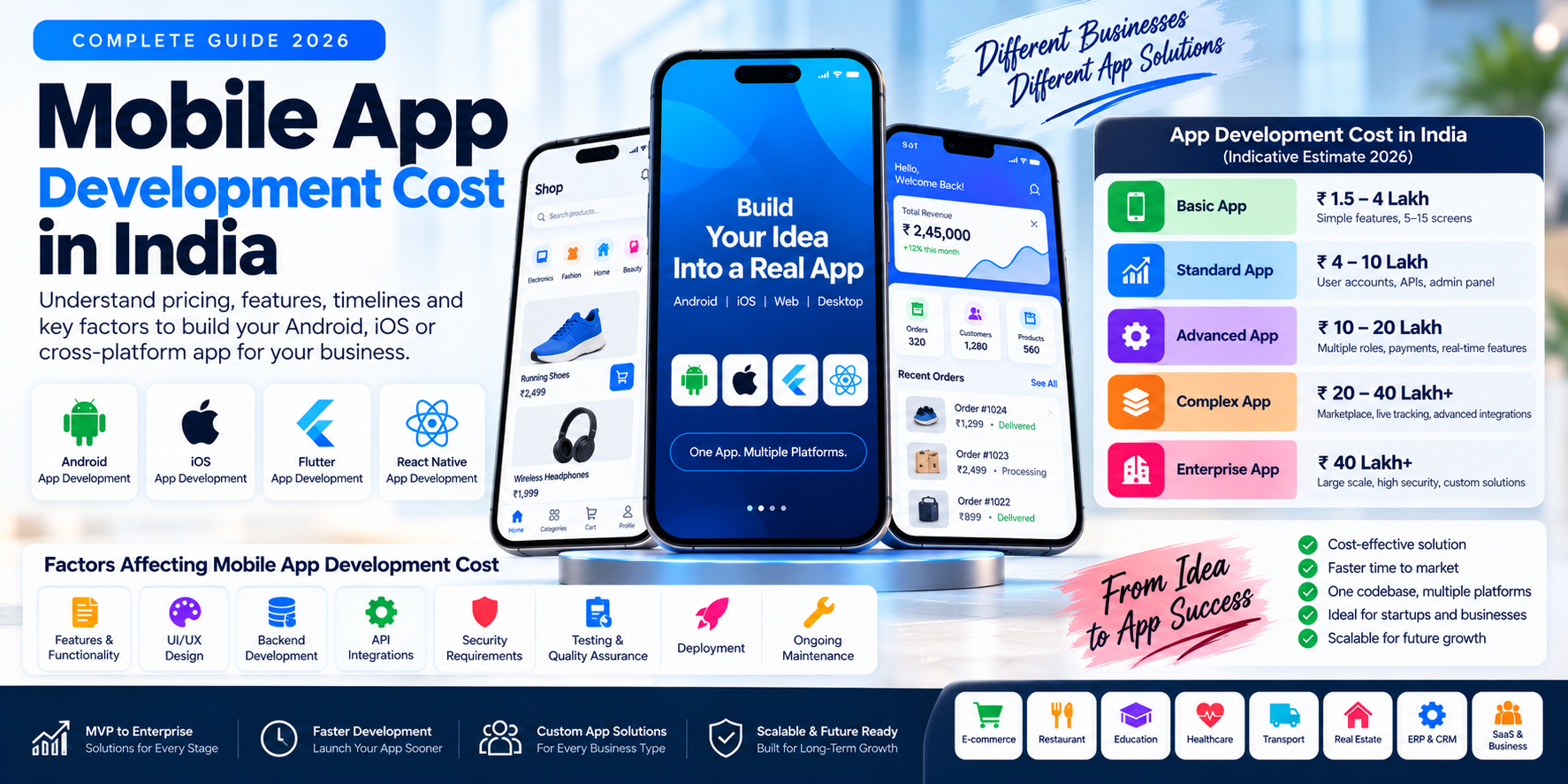
| App Type | Indicative Cost |
|---|---|
| Basic Mobile App | ₹1.5 lakh – ₹4 lakh |
| Standard Business App | ₹4 lakh – ₹10 lakh |
| Advanced Mobile App | ₹10 lakh – ₹20 lakh |
| Complex App / Platform | ₹20 lakh – ₹40 lakh+ |
| Enterprise / Highly Specialized App | ₹40 lakh+ |
These are planning ranges, not fixed market prices or guaranteed quotations.
The actual cost depends on:
- Number of screens
- Number of features
- Android/iOS requirements
- Native or cross-platform technology
- UI/UX complexity
- Backend requirements
- Admin panel
- APIs
- Payment gateway
- Maps and GPS
- Notifications
- Third-party integrations
- Security requirements
- Testing
- Deployment
- Post-launch support
Two apps described as "business apps" can therefore have very different development costs.
2. Why Is There Such a Big Difference in App Development Cost?
Consider two applications.
App A: Simple Business App
It may contain:
- Home
- About
- Services
- Contact
- Login
- Basic enquiry form
The development scope is relatively limited.
App B: Complete Business Platform
It may require:
- Customer registration
- Staff accounts
- Vendor accounts
- Product management
- Orders
- Payments
- Inventory
- Notifications
- GPS
- Reports
- Chat
- API integrations
- Admin panel
- Multiple permission levels
The second application requires significantly more design, development, testing and infrastructure.
Therefore, the number of features and complexity of workflows usually matter more than simply asking whether an app is Android or iOS.
3. Mobile App Development Cost by Complexity
Basic App – ₹1.5 Lakh to ₹4 Lakh
A basic application may include:
- 5–15 screens
- Static or limited dynamic content
- Basic navigation
- Simple forms
- Contact/enquiry functionality
- Basic API integration
- Basic backend
Examples:
- Company information app
- Small service app
- Simple utility
- Internal information application
- Basic customer application
Standard Business App – ₹4 Lakh to ₹10 Lakh
A standard application may include:
- User registration
- Login
- User profile
- Dashboard
- API integration
- Notifications
- Database
- Admin panel
- Search
- Basic reports
- Business workflows
This category can cover many normal business applications.
Advanced App – ₹10 Lakh to ₹20 Lakh
An advanced application can include:
- Multiple user roles
- Payment integration
- Advanced dashboards
- Real-time data
- GPS/location
- Push notifications
- Complex APIs
- Advanced admin panel
- Analytics
- File/document management
- Custom business workflows
Complex Platform – ₹20 Lakh to ₹40 Lakh+
A complex application could include:
- Customer application
- Vendor application
- Delivery/field application
- Admin application
- Web administration
- Real-time tracking
- Payments
- Commission management
- Advanced analytics
- Multiple APIs
- Large database
- Complex business logic
Examples include large marketplaces, logistics platforms, sophisticated SaaS products and multi-sided business systems.
4. Android App Development Cost in India
Android development can range from a relatively small project to a large enterprise application.
The cost depends on the application's functionality rather than simply the Android platform.
An Android application might include:
- User login
- OTP authentication
- Product catalogue
- Shopping cart
- Payments
- Orders
- GPS
- Push notifications
- Camera
- Document uploads
- Chat
- Reports
- API integration
For businesses targeting Android users, it is important to define the supported Android versions and device range during planning.
Read more:
Android App Development Company in India
5. iOS App Development Cost in India
iOS development has its own platform-specific requirements.
An iOS project may include:
- User authentication
- Apple account integration
- Payments
- Push notifications
- Camera
- Location
- Subscription functionality
- API integration
- Custom UI
- Analytics
If a business needs both Android and iOS applications, it needs to decide whether to develop them separately or use a cross-platform technology.
Read more:
iOS App Development Company in India
6. Flutter App Development Cost
Flutter is designed for developing applications across multiple platforms from a shared codebase, while still allowing access to platform-specific functionality when required. Flutter currently supports mobile, desktop and web deployment.
A Flutter project can therefore be suitable for businesses that want Android and iOS applications from a common development approach.
However, Flutter does not mean that every app automatically costs half as much.
The project can still require:
- Backend development
- API development
- Native integrations
- Platform-specific configuration
- Testing
- App-store deployment
- Security work
- Third-party services
Flutter also supports platform interoperability through mechanisms such as platform channels when applications need to communicate with native Android or iOS code.
Read our detailed guide:
Flutter App Development Cost in India
7. Cross-Platform App Development Cost
Cross-platform development can be considered when a company wants to target multiple platforms while sharing application code.
Possible technologies include:
- Flutter
- React Native
- Other cross-platform frameworks
The final cost still depends on the application's features and integrations.
For example, a simple cross-platform application can be relatively straightforward, while a complex application using Bluetooth, GPS, background services, payments and native SDKs may require additional platform-specific engineering.
8. Native vs Cross-Platform App Development
One of the most important decisions is whether to build:
Separate native applications
or
A cross-platform application
Native Development
Android and iOS applications are developed using their respective platform technologies.
Potential considerations:
- Platform-specific development
- Platform-specific testing
- Separate codebases
- Native APIs
- Platform-specific UI
Cross-Platform Development
A framework such as Flutter can allow substantial code sharing across supported platforms.
Potential considerations:
- Shared codebase
- Common development workflow
- Cross-platform UI
- Native integrations when required
- Platform-specific testing
There is no universal answer for every project.
The decision should be based on:
- Required features
- Target platforms
- Performance requirements
- Existing technology
- Development team
- Long-term maintenance
- Budget
- Third-party SDK requirements
9. Mobile App Development Cost by Industry
Different industries require different application workflows.
E-commerce App
Possible features:
- Product catalogue
- Categories
- Search
- Filters
- Cart
- Checkout
- Payments
- Orders
- Coupons
- Inventory
- Delivery tracking
School App
Possible features:
- Student login
- Parent login
- Staff login
- Attendance
- Homework
- Fees
- Examination
- Results
- Notifications
- Communication
For example, Cycode Technologies' EduMittar ecosystem includes multiple user-facing applications and school management functionality.
Restaurant App
Features may include:
- Digital menu
- Table ordering
- Takeaway
- Delivery
- Online payment
- Order tracking
- Kitchen workflow
Hospital App
Potential functionality:
- Patient registration
- Appointment booking
- Doctor profiles
- Reports
- Billing
- Notifications
- Pharmacy integration
Transport App
Potential features:
- Driver application
- Customer application
- Vehicle management
- Trip management
- GPS
- Route information
- Reports
- Notifications
Real Estate App
Potential functionality:
- Property listings
- Search
- Filters
- Location
- Agent profiles
- Enquiries
- Property images
- Appointment requests
10. Backend Development and Its Impact on App Cost
A mobile application is often only one part of the complete system.
A business application may require:
Mobile App → API → Backend → Database → Admin Panel
The backend may manage:
- Users
- Authentication
- Permissions
- Products
- Orders
- Payments
- Business logic
- Notifications
- Reports
- Files
- Data synchronization
For a small app, the backend may be relatively simple.
For an ERP, marketplace, SaaS or large business platform, the backend can become one of the most important parts of the project.
11. Admin Panel Development Cost
Many mobile applications need a web-based administration system.
An admin panel can allow business owners to manage:
- Users
- Products
- Orders
- Payments
- Content
- Reports
- Employees
- Notifications
- Settings
- Permissions
A simple admin panel may have only a few modules.
A complete business management dashboard may contain dozens of screens and workflows.
Therefore, admin panel requirements should always be included when requesting a mobile app quotation.
12. API Development and Integration
Modern applications frequently communicate with other systems.
Examples include:
- Payment gateways
- SMS providers
- Email services
- WhatsApp services
- Maps
- GPS
- CRM
- ERP
- Accounting software
- Shipping systems
- Authentication services
Flutter's architecture also supports communication with native platform code when a project requires platform-specific functionality.
Every integration introduces its own requirements for authentication, error handling, testing and maintenance.
13. UI/UX Design and Mobile App Cost
A professional application needs more than attractive screens.
UI/UX planning should consider:
- User journeys
- Navigation
- Forms
- Search
- Error states
- Empty states
- Loading states
- Responsive layouts
- Accessibility
- Touch interactions
- Brand consistency
A basic app might use a relatively small number of reusable components.
A large platform may require hundreds of UI states.
Therefore, UI/UX should be treated as an actual project phase rather than an afterthought.
14. Security Requirements
Security requirements can also affect development cost.
Depending on the application, you may need:
- Secure authentication
- Role-based access
- API authentication
- Encryption
- Secure file storage
- Session management
- Audit logs
- Backup systems
- Access controls
- Security testing
An application dealing with business, financial or personal information may require more extensive security planning than a simple informational app.
15. Testing and Quality Assurance
Testing should happen throughout development rather than only immediately before launch.
Testing may include:
Functional Testing
Does every feature behave as expected?
Device Testing
Does the app work correctly across supported devices?
API Testing
Does the application communicate correctly with the backend?
Payment Testing
Do payment and transaction workflows behave correctly?
Performance Testing
Does the application remain responsive under expected conditions?
Security Testing
Are authentication and access controls working correctly?
Regression Testing
Do new changes break existing functionality?
The larger the application, the more important systematic testing becomes.
16. Mobile App Development Timeline
A project's timeline depends on its scope.
Indicative planning:
| Project | Possible Timeline |
|---|---|
| Basic app | 4–8 weeks |
| Standard business app | 8–16 weeks |
| Advanced app | 3–6 months |
| Complex platform | 6–12+ months |
These are broad planning estimates, not delivery guarantees.
Factors that can affect timelines include:
- Requirement changes
- Design approval
- API availability
- Third-party integrations
- Client feedback
- Testing
- App-store review
- Backend complexity
- Data migration
A clear scope and approval process can make project planning easier.
17. Hidden Costs of Mobile App Development
The development quotation isn't necessarily the entire cost of running an app.
Businesses should also consider:
Cloud Hosting
Backend servers, databases, storage and bandwidth.
Third-Party APIs
Maps, SMS, email, payment and other services.
Maintenance
Bug fixes, compatibility updates and technical improvements.
App Store Operations
Publishing, account management and release requirements.
Marketing
Advertising, SEO, social media, content and user acquisition.
Customer Support
If the application is customer-facing, support and operational staff may also be required.
18. How to Reduce Mobile App Development Cost
Reducing cost does not necessarily mean removing important engineering work.
A better approach is scope management.
Start With an MVP
Build the essential version first.
Version 1
- Registration
- Login
- Main dashboard
- Core service
- Basic notifications
Version 2
- Advanced analytics
- Additional integrations
- Loyalty system
- Automation
- Advanced reporting
This approach can allow a business to validate its product before investing in every planned feature.
19. Don't Choose an App Development Company Only by Price
A lower quotation does not necessarily mean lower total project cost.
When evaluating a development proposal, examine:
- What features are included?
- Is UI/UX included?
- Is backend development included?
- Is the admin panel included?
- Are APIs included?
- Is testing included?
- Is deployment included?
- How are future changes handled?
- What support is included?
- Who owns the source code?
- What happens after launch?
A ₹3 lakh quotation and a ₹6 lakh quotation may describe very different scopes.
The correct comparison is therefore scope + technology + deliverables + support, not only the headline price.
20. Choosing the Right Mobile App Technology
A practical technology decision should consider the application rather than following a trend.
Consider Native Development When:
- Deep platform-specific functionality is essential
- Platform-specific experiences are a major requirement
- Native SDK integration dominates the project
Consider Flutter When:
- Android and iOS are both important
- Shared application code is desirable
- Custom UI is important
- A common development approach fits the project
Flutter's official architecture documentation describes it as a cross-platform UI toolkit designed for code reuse while still supporting integration with underlying platform services.
Consider Other Cross-Platform Technologies When:
- Your team already has expertise in another framework
- Existing code or infrastructure favors another technology
- Specific project requirements make another approach more suitable
21. Building Scalable Mobile Applications
A mobile app should not only work today.
It should be designed with realistic future requirements in mind.
Flutter's architecture guidance recommends separation of concerns between UI and data layers and describes patterns such as views, view models, repositories and services as one approach to structuring applications.
For a business application, good architecture can help organize:
UI
↓
Business Logic
↓
Services / APIs
↓
Database
↓
External Integrations
This becomes increasingly important as an application grows.
22. Mobile App Development Company in Hansi, Hisar & India
Businesses searching for a mobile app development company in Hansi, Hisar, Haryana or India may need more than a mobile application.
A complete digital solution may include:
- Mobile applications
- Web applications
- Backend APIs
- Admin panels
- ERP systems
- SaaS platforms
- Payment integration
- Business automation
- Cloud infrastructure
Cycode Technologies develops custom software and mobile applications for businesses and organizations.
Our mobile development services can include:
- Android app development
- iOS app development
- Flutter app development
- Cross-platform applications
- API development
- Backend development
- Admin dashboards
- Business application development
- SaaS applications
- E-commerce applications
- ERP-connected mobile applications
Whether you are building a startup MVP or extending an existing business system to mobile, the project should begin with a clear understanding of users, workflows and technical requirements.
23. How to Get an Accurate Mobile App Development Quote
Before contacting an app development company, prepare the following information:
1. App Purpose
What problem does the app solve?
2. Target Users
Who will use it?
- Customers
- Employees
- Vendors
- Students
- Drivers
- Doctors
- Administrators
- Other users
3. Platforms
Do you need:
- Android
- iOS
- Both
- Web
- Desktop
4. Features
List the essential features for the first version.
5. Backend
Do you already have APIs or does the backend need to be developed?
6. Admin Panel
What should administrators be able to manage?
7. Integrations
List payment, GPS, SMS, WhatsApp, accounting, ERP or other integrations.
8. Design
Do you already have Figma/UI designs?
9. Existing System
Does the app need to connect with your existing website, ERP, CRM or SaaS?
10. Support
Do you require ongoing maintenance after launch?
The more complete this information is, the more useful the development estimate will be.
24. Frequently Asked Questions
How much does it cost to develop a mobile app in India?
An indicative budget can range from around ₹1.5 lakh for a basic application to ₹40 lakh or more for complex platforms. The actual price depends on features, technology, backend, integrations, design, testing and support.
How much does an Android app cost in India?
There is no fixed price. A basic Android application may require a smaller budget, while applications involving payments, APIs, GPS, multiple users and complex backend systems can cost considerably more.
How much does an iOS app cost in India?
The cost depends on the application's features, UI/UX, backend, integrations, testing and platform requirements.
Is Flutter cheaper than native app development?
Flutter can enable substantial code sharing across platforms, which may reduce duplicated development work. However, total cost depends on the application's requirements and any platform-specific functionality.
How much does an e-commerce mobile app cost?
The cost depends on whether the application includes only shopping functionality or also requires vendor management, inventory, delivery, payments, commissions, administration and other marketplace features.
How much does a business app cost?
A standard business application can fall within the mid-range of the indicative pricing above, but the actual budget depends on the number of workflows and integrations.
Can I develop Android and iOS apps together?
Yes. You can develop separate native applications or use a cross-platform framework such as Flutter. Flutter officially supports Android and iOS deployment along with other platforms.
Does mobile app development include a website?
Not necessarily. A mobile application, backend, admin panel and website are separate deliverables unless they are specifically included in the project scope.
How long does mobile app development take?
A basic app may take several weeks, while advanced and complex platforms can take several months. The timeline depends heavily on scope, integrations, testing and feedback cycles.
Can you connect my existing ERP or website to a mobile app?
Yes, where the existing system provides suitable APIs or another secure integration mechanism. The existing architecture should be assessed before committing to the integration approach.
25. Final Thoughts
The cost of mobile app development in India in 2026 depends much more on the application's scope than on a single technology or number of screens.
A successful project should consider:
Requirements → UI/UX → Technology → Backend → APIs → Security → Testing → Deployment → Maintenance
If your requirements are clearly defined, you can compare development proposals more meaningfully and avoid unexpected costs later.
For businesses in Hansi, Hisar, Haryana and across India, Cycode Technologies can help plan and develop custom mobile applications connected with websites, APIs, ERP systems, SaaS platforms and other business software.
Have an app idea?
Contact Cycode Technologies to discuss the required features, technology approach, development scope and estimated budget.
Website: cycodetech.com
Contact: 8950008824