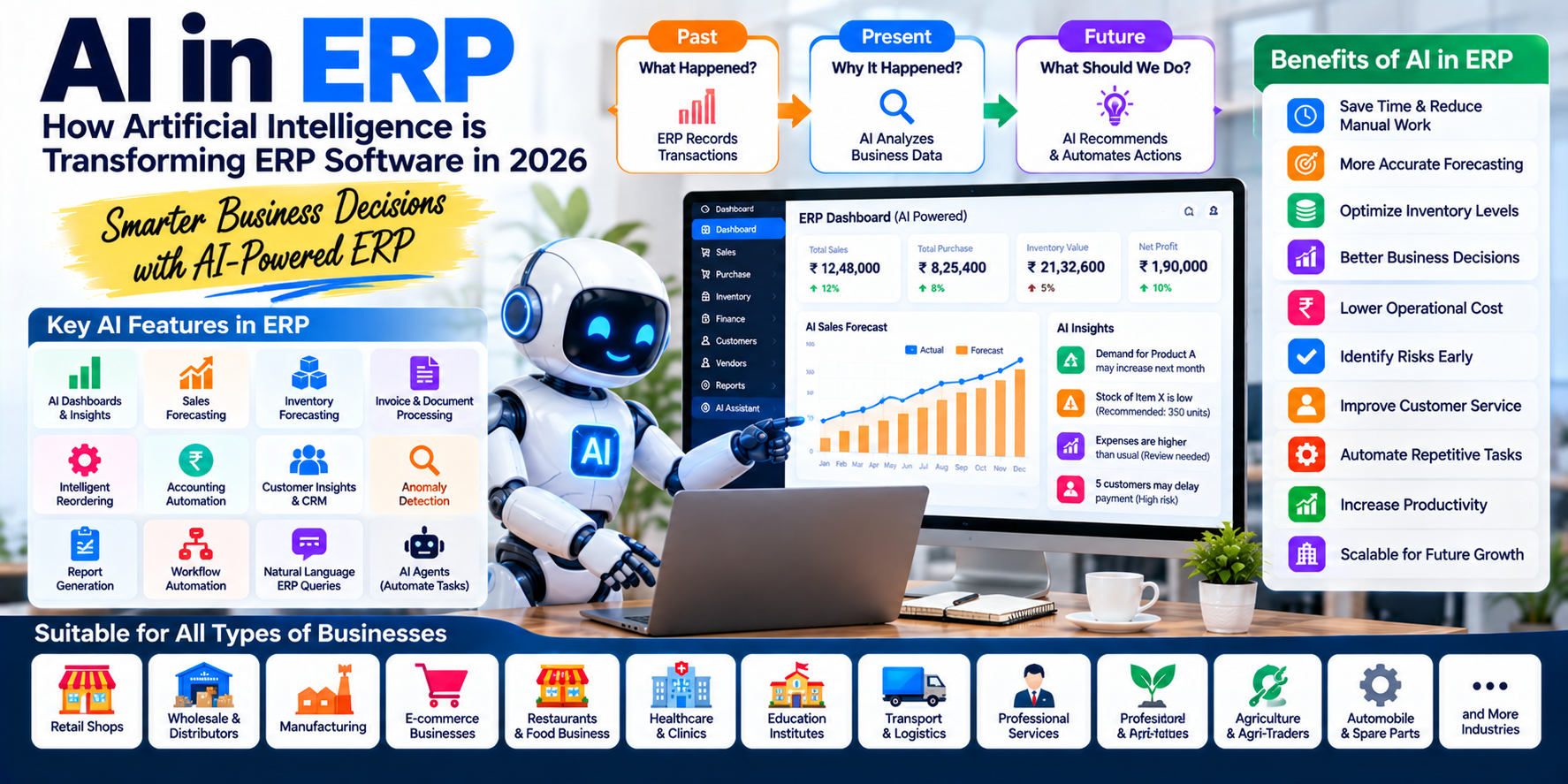
AI in ERP: How Artificial Intelligence Is Transforming ERP Software in 2026
ERP software has traditionally been the system of record for a business.
It stores transactions.
It manages accounting.
It tracks inventory.
It records sales and purchases.
It manages employees and business processes.
But modern ERP systems are beginning to do more than simply record what happened.
With the integration of artificial intelligence, predictive analytics, generative AI and increasingly agentic AI, ERP software is evolving toward systems that can analyze information, identify patterns, recommend actions and, in some cases, execute parts of a workflow.
Gartner's 2026 ERP research describes AI-powered ERP as moving traditional systems of record toward real-time intelligence, automation and action, while emphasizing connected data and flexible cloud-based ERP architectures.
McKinsey similarly describes AI and agentic systems as moving beyond isolated task automation toward the orchestration of broader enterprise processes.
For Indian businesses, this creates an important opportunity:
ERP can evolve from software that tells you what happened into software that helps you understand what is happening, what may happen next, and what action could be taken.
What Is AI in ERP?
AI in ERP means integrating artificial intelligence capabilities into ERP data, modules and workflows.
Depending on the system, AI can support activities such as:
- Forecasting
- Data analysis
- Anomaly detection
- Document processing
- Natural-language queries
- Sales predictions
- Inventory forecasting
- Financial analysis
- Automated recommendations
- Workflow automation
- Customer communication
- Report generation
- Intelligent assistants
- AI agents
A 2026 systematic review of AI-powered ERP research identifies automation, predictive analytics and generative AI among the major themes shaping the field.
This means AI does not represent one single ERP feature.
It is a layer of capabilities that can be applied across different ERP modules.
Traditional ERP vs AI-Powered ERP
The difference can be understood simply.
Traditional ERP
Transaction happens
↓
ERP records it
↓
User opens report
↓
User analyzes information
↓
User decides what to do
↓
User performs action
AI-Enhanced ERP
Transaction happens
↓
ERP records it
↓
AI analyzes information
↓
AI identifies pattern/anomaly
↓
AI provides recommendation
↓
User approves or automated workflow acts
This doesn't mean every AI ERP should operate autonomously.
For financial, compliance, purchasing and other sensitive activities, businesses may want human approval and defined controls.
That distinction is becoming increasingly important as AI moves from assistants toward agents.
Why Is AI Becoming Important in ERP?
ERP contains valuable business information.
For example:
- Sales data
- Purchase data
- Inventory data
- Customer data
- Financial data
- Employee data
- Operational data
These connected datasets can provide a detailed picture of how the organization operates.
AI can potentially analyze these connected datasets much faster than traditional manual analysis.
Current ERP research highlights AI's growing role in improving insight, productivity, automation and decision-making.
The real opportunity is therefore not simply adding a chatbot to an ERP.
It is making business data more useful and actionable.
15 Major Applications of AI in ERP
Let's examine where AI can be useful.
1. AI-Powered ERP Dashboards
Traditional dashboards display numbers.
AI-powered dashboards can potentially explain those numbers.
For example:
Sales: ₹42 lakh
Instead of stopping there, an AI assistant could help answer:
- Why did sales change?
- Which products contributed most?
- Which branch performed best?
- Which customers changed their purchasing pattern?
- Which products are declining?
- What should management investigate?
The objective is to move from:
Data → Information → Insight
2. AI Sales Forecasting
AI can analyze historical sales information to help estimate future demand.
Possible inputs include:
- Historical sales
- Product trends
- Seasonal patterns
- Customer behavior
- Regional performance
- Sales velocity
- Previous orders
For example:
"Based on recent sales patterns, Product A may require higher stock levels next month."
A forecast is not a guarantee.
Its value depends heavily on the quality, completeness and relevance of the underlying data.
3. AI Inventory Forecasting
Inventory is another major AI opportunity.
An AI-enabled ERP could analyze:
- Historical sales
- Current stock
- Purchase history
- Supplier lead time
- Seasonal demand
- Product movement
- Warehouse data
It could then identify potential:
Stockout Risk
or:
Overstock Risk
For example:
"Inventory for Product X has declined faster than its recent average. Consider reviewing replenishment requirements."
This is different from a simple low-stock alert because the system can potentially consider multiple variables.
4. Intelligent Reordering
Traditional inventory systems may use a fixed rule:
If stock < 20 → reorder
AI-based systems can potentially consider:
- Historical demand
- Expected demand
- Supplier lead time
- Seasonal patterns
- Sales trends
- Existing purchase orders
The resulting recommendation could be:
Suggested Order: 350 units
rather than simply:
Stock below threshold.
The final purchasing decision can remain with an authorized employee.
5. AI for Accounting
Accounting is another area where AI can support repetitive work.
Potential applications include:
- Invoice data extraction
- Transaction classification
- Expense categorization
- Anomaly detection
- Reconciliation assistance
- Duplicate invoice detection
- Financial summaries
- Cash-flow analysis
AI does not eliminate the need for accounting controls.
Instead, it can assist accountants by reducing repetitive processing and highlighting transactions that deserve attention.
6. AI Invoice Processing
Businesses receive invoices in many formats:
- Scanned documents
- Email attachments
- Images
- Digital documents
AI-powered document processing can extract information such as:
- Supplier
- Invoice number
- Date
- Tax information
- Items
- Quantities
- Amount
- Total
The extracted information can then be validated before entering the ERP.
This can reduce manual data entry.
7. AI Financial Forecasting
Management often wants answers to questions such as:
- How much cash may be available next month?
- Which customers may delay payment?
- What are the major expense trends?
- How are margins changing?
- What could affect profitability?
AI can analyze historical financial information and generate forecasts or highlight unusual patterns.
The accuracy of such predictions depends on the quality and consistency of financial data.
8. AI Anomaly Detection
Anomaly detection can help identify transactions that appear unusual.
Examples:
- Unusually large expense
- Unexpected inventory adjustment
- Abnormal sales transaction
- Duplicate invoice
- Unusual discount
- Unexpected purchasing pattern
- Significant change in customer activity
Instead of manually checking every transaction, employees can investigate items flagged by the system.
9. AI Customer and Sales Assistance
AI can also work with CRM and sales information.
Potential capabilities include:
- Lead prioritization
- Customer summaries
- Follow-up suggestions
- Sales opportunity analysis
- Customer segmentation
- Automated response drafting
- Sales forecasting
For example:
"This customer has not placed an order in 75 days and previously purchased Product A every month."
The salesperson can then decide whether a follow-up is appropriate.
10. Natural-Language ERP Queries
One of the most visible changes in AI-enabled ERP is the ability to ask questions in normal language.
Instead of navigating through several reports, a manager could ask:
"What were our highest-selling products last month?"
or:
"Which customers have outstanding payments above ₹1 lakh?"
or:
"Show me the branches with declining sales."
The AI interface can translate the question into a data query and present an answer.
However, organizations should ensure that AI assistants respect user permissions and data-access controls.
11. AI Report Generation
ERP systems contain huge amounts of structured data.
AI can help turn that information into readable summaries.
Monthly Business Summary
- Sales increased
- Inventory declined in category A
- Receivables increased
- Branch B exceeded its target
- Product C became slow-moving
Instead of reading multiple reports, management can receive a concise business summary.
12. AI Document Management
AI can help businesses classify and process documents.
Potential applications include:
- Invoice classification
- Contract extraction
- Employee document classification
- Purchase document processing
- Customer document extraction
- Search across business documents
A user might ask:
"Find all supplier contracts expiring in the next 60 days."
An AI-enabled document system could potentially identify the relevant documents and dates.
13. AI Workflow Automation
Traditional automation follows predefined rules.
For example:
IF stock < 20 → send alert
AI-enabled automation can potentially consider more context.
For example:
Demand increasing + stock declining + supplier lead time increasing
        ↓
Recommend replenishment
        ↓
Create draft purchase order
        ↓
Send for approval
This is where AI starts connecting analytics with workflow automation.
14. Agentic AI in ERP
One of the most important emerging developments is agentic AI.
A conventional AI assistant might answer:
"Which invoices are overdue?"
An AI agent may potentially go further:
Identify overdue invoices → prioritize them → draft reminders → send approved communications → update status.
The difference is that an agent can potentially perform multi-step tasks rather than simply responding to questions.
McKinsey describes agentic systems as increasingly capable of orchestrating enterprise processes rather than only automating individual tasks.
However, autonomous action should not mean uncontrolled action.
Sensitive workflows should have:
- Permission controls
- Approval thresholds
- Audit logs
- Human oversight
- Clear accountability
15. AI-Powered Business Assistants
A future-oriented ERP could provide a central AI business assistant.
For example:
Manager:
"How is the business performing this month?"
ERP AI:
"Sales are ₹48 lakh, up 9% from the previous month. Inventory value is ₹21 lakh. Receivables above 30 days increased by 7%. The North branch has the strongest sales growth."
The manager can then ask:
"Why did receivables increase?"
and continue the analysis conversationally.
This can make ERP systems easier to interact with for non-technical users.
AI Across Different ERP Modules
AI can potentially be applied across almost every major ERP area.
| ERP Module | Potential AI Applications |
|---|---|
| Accounting | Reconciliation, anomaly detection, summaries |
| Finance | Forecasting, cash-flow analysis |
| Sales | Forecasting, lead scoring, recommendations |
| CRM | Customer insights, follow-up assistance |
| Inventory | Demand forecasting, stock optimization |
| Purchase | Supplier analysis, reorder recommendations |
| HR | Employee analytics, document processing |
| Payroll | Exception detection and assistance |
| Manufacturing | Demand planning, quality analysis |
| Warehouse | Stock optimization, workflow assistance |
| Projects | Risk analysis, forecasting |
| Reporting | Natural-language summaries |
| Documents | Data extraction and classification |
| Customer Service | AI-assisted responses |
| Management | Business intelligence and decision support |
AI in ERP for Small Businesses
AI is not only relevant to large enterprises.
Small businesses can potentially benefit from AI-enabled ERP features such as:
Automated Invoice Processing
Reduce manual invoice entry.
Sales Insights
Identify products and customers driving revenue.
Inventory Forecasting
Improve stock planning.
Expense Analysis
Identify unusual spending patterns.
Business Summaries
Get a simplified overview of business performance.
Customer Follow-Ups
Identify customers who may require attention.
Natural-Language Reports
Ask questions without manually building complex reports.
However, smaller businesses should prioritize practical use cases rather than adopting AI simply because it is available.
AI in ERP for Indian Businesses
Indian businesses operate in a diverse environment involving:
- GST
- Multiple business locations
- Local suppliers
- Distributors
- Retailers
- Manufacturing
- E-commerce
- Digital payments
- WhatsApp communication
- Large SME and MSME ecosystems
AI can potentially be applied to these workflows.
For example:
Retail
AI sales forecasting + inventory optimization.
Wholesale
Customer demand analysis + purchase recommendations.
Manufacturing
Production planning + demand forecasting.
Transport
Maintenance prediction + operational analytics.
Healthcare
Appointment analysis + inventory insights.
Education
Student analytics + fee and attendance insights.
The important point is that AI should be connected to a well-structured operational system.
AI Cannot Fix Poor ERP Data
This is one of the most important considerations.
AI depends heavily on the data available to it.
If the ERP contains:
- Duplicate customers
- Incorrect inventory
- Missing transactions
- Inconsistent product names
- Incorrect financial records
- Incomplete historical data
then AI-generated insights can also become unreliable.
The Confederation of Indian Industry's 2026 report on AI and ERP specifically highlights data readiness, governance and execution maturity as challenges for organizations seeking value from AI-enabled ERP.
Therefore:
Good AI starts with good business data.
AI ERP Requires Security and Governance
ERP contains sensitive information.
This can include:
- Financial records
- Customer information
- Employee data
- Supplier information
- Business strategies
- Pricing
- Inventory
- Contracts
AI access must therefore be carefully controlled.
Important considerations include:
Role-Based Access
AI should only access information the user is authorized to see.
Audit Logs
Important AI actions should be traceable.
Approval Workflows
Sensitive transactions may require human approval.
Data Protection
Business information should be protected according to the organization's security requirements.
Model Governance
Businesses should understand what AI is allowed to do and where it should not operate autonomously.
AI vs Traditional ERP Automation
These two concepts should not be confused.
Rule-Based Automation
IF
Invoice is overdue
THEN
Send reminder.
The logic is predefined.
AI-Assisted Automation
The system may consider:
- Customer history
- Payment behavior
- Invoice amount
- Previous communication
- Risk indicators
and recommend an appropriate next action.
Agentic Automation
The system may potentially:
- Identify overdue invoices
- Prioritize them
- Draft communication
- Request approval
- Send communication
- Update records
The latter requires significantly stronger governance and controls.
Does Every Business Need AI in ERP?
No.
A business should not adopt AI simply because it is a current technology trend.
Start by identifying a real problem.
Problem
Employees spend hours entering supplier invoices.
Potential solution: AI document extraction.
Problem
Stockouts happen frequently.
Potential solution: Demand forecasting.
Problem
Management spends hours preparing reports.
Potential solution: AI-generated reporting and summaries.
Problem
Salespeople don't know which customers need follow-up.
Potential solution: AI-assisted customer analysis.
The best AI implementation is usually the one connected to a measurable business problem.
How to Implement AI in ERP
A practical roadmap can look like this:
Step 1 — Identify the Business Problem
Choose one process where AI could provide measurable value.
Step 2 — Review Data Quality
Check whether the ERP contains enough reliable information.
Step 3 — Start With a Low-Risk Use Case
Examples:
- Reporting
- Document extraction
- Forecasting assistance
- Data analysis
Step 4 — Integrate AI With ERP Data
Connect AI to authorized datasets and workflows.
Step 5 — Establish Permissions
Define exactly what the AI can read and what it can do.
Step 6 — Add Human Approval
Keep humans in control of high-impact actions.
Step 7 — Measure Results
Track metrics such as:
- Processing time
- Error reduction
- Productivity
- Forecast accuracy
- Cost savings
- Response time
Step 8 — Expand Gradually
Once the first use case proves useful, introduce additional AI workflows.
This is particularly important because current enterprise AI discussions increasingly emphasize measurable business outcomes rather than simply increasing the number of AI deployments.
What Will ERP Look Like in the Future?
ERP is gradually moving toward a model where users interact with business systems more naturally.
Instead of:
Open Module → Select Report → Apply Filters → Export → Analyze
the future interaction may look more like:
"Show me why profit decreased this quarter."
Then:
"Compare it with the previous quarter."
Then:
"Which products caused the biggest change?"
Then:
"Prepare a purchase recommendation based on the latest demand."
The ERP becomes a business intelligence and action layer, not just a database of transactions.
Gartner's 2026 ERP research identifies this broader movement toward intelligent, connected and increasingly automated ERP architectures.
AI in ERP vs AI-Native ERP
These terms are related but not identical.
AI-Enabled ERP
An existing ERP gains AI capabilities.
For example:
Traditional ERP + AI assistant + forecasting + automation
AI-Native ERP
AI is part of the architecture and user experience from the beginning.
The distinction matters because an AI chatbot added to an ERP is very different from an ERP designed around intelligent workflows.
Businesses evaluating vendors should therefore ask:
- What AI features actually exist today?
- Are they production-ready?
- What data do they require?
- Can users control them?
- What actions can they perform?
- What does the AI cost?
- How is access controlled?
This is especially relevant because AI capabilities vary widely between ERP products, and some are offered as additional paid functionality. Current 2026 ERP research shows substantial variation in what AI features are actually available and how they are packaged.
How Much Does AI ERP Cost?
There is no universal price for an AI-enabled ERP.
Cost can depend on:
- ERP platform
- Number of users
- AI features
- Data volume
- AI model/provider
- Integrations
- Custom development
- Cloud infrastructure
- Automation requirements
- Mobile applications
- Implementation
- Support
A simple ERP with an AI reporting assistant will have a very different cost structure from a custom ERP containing:
AI Forecasting + Document Processing + AI Assistant + Automated Workflows + AI Agents + Multiple Integrations
Therefore, businesses should evaluate AI functionality as part of the overall ERP architecture and total cost of ownership.
For broader ERP pricing, see:
ERP Software Cost in India (2026)
AI ERP for Different Industries
Retail
AI can potentially help with:
- Demand forecasting
- Stock recommendations
- Product analysis
- Customer insights
- Sales forecasting
Manufacturing
Potential applications include:
- Production forecasting
- Demand planning
- Quality analysis
- Procurement optimization
- Maintenance insights
Wholesale & Distribution
AI can support:
- Customer demand prediction
- Inventory planning
- Sales forecasting
- Supplier analysis
- Receivables insights
Transport
Potential applications include:
- Maintenance prediction
- Fuel analysis
- Route analytics
- Fleet performance
Healthcare
AI-enabled ERP or healthcare systems may support:
- Operational analytics
- Inventory forecasting
- Appointment insights
- Resource planning
Education
Potential applications include:
- Student analytics
- Fee collection insights
- Attendance analysis
- Resource planning
The exact use cases should be evaluated against the organization's data, workflows and regulatory requirements.
AI and ERP for Hansi, Hisar, Haryana and India
Businesses in Hansi, Hisar, Rohtak, Jind, Bhiwani and across Haryana operate across retail, manufacturing, distribution, education, healthcare, transport, agriculture and professional services.
As businesses digitize their operations, AI can become an additional layer over ERP and business software.
For example:
Retailer
ERP: Sales + Inventory + Accounting
AI: Demand Forecasting + Product Insights
Manufacturer
ERP: Production + Inventory + Purchase
AI: Demand Forecasting + Production Insights
Distributor
ERP: Sales + Warehouse + Receivables
AI: Customer Demand + Reorder Recommendations
Service Company
ERP: CRM + Projects + Billing
AI: Lead Insights + Reporting + Follow-Up Assistance
The objective should be practical: use AI where it can improve a measurable business process.
AI and ERP Development at Cycode Technologies
Cycode Technologies develops ERP, SaaS and custom business software across multiple industries.
Its existing software ecosystem includes:
- AccuBook — accounting and business financial management
- Vendly — accounting, inventory and business ERP
- EduMittar — school management ERP
- FleetLogic — transport and fleet management
- KwikDine — restaurant POS and ordering
- PulsePanel — hospital and clinic management
- CyFlo — modular business SaaS platform
AI capabilities can be considered as an additional layer within suitable business systems, including:
- AI dashboards
- Business insights
- Forecasting
- Document processing
- Intelligent reporting
- Workflow automation
- AI assistants
- API-connected AI services
- Industry-specific AI workflows
For a custom ERP project, AI should be introduced according to the business process, available data, security requirements and measurable objective rather than simply adding AI for marketing purposes.
Frequently Asked Questions
What is AI in ERP?
AI in ERP means integrating artificial intelligence capabilities into ERP data, modules and workflows to support analysis, prediction, automation, recommendations and decision-making.
What can AI do in ERP?
AI can potentially support forecasting, anomaly detection, document processing, reporting, customer analysis, inventory planning, financial analysis, natural-language queries and workflow automation.
Can AI automate ERP processes?
Yes, AI can assist or automate certain ERP workflows. However, sensitive business actions should generally have appropriate permissions, controls and human oversight.
What is agentic AI in ERP?
Agentic AI refers to AI systems capable of carrying out multi-step tasks toward a goal rather than simply responding to individual prompts. In ERP, this could involve identifying an issue, determining a next action and executing approved workflow steps.
Can AI predict inventory requirements?
AI can analyze historical sales, inventory and other relevant information to generate demand or replenishment forecasts. The quality of the forecast depends on the quality and relevance of the underlying data.
Can AI be used for accounting?
AI can assist with activities such as document extraction, transaction classification, anomaly detection, reconciliation assistance and financial analysis. It should not replace appropriate accounting controls and professional review.
Is AI ERP suitable for small businesses?
It can be, particularly when AI addresses a specific operational problem such as invoice processing, inventory forecasting, reporting or customer follow-up. Businesses should start with practical use cases rather than adopting AI features without a clear objective.
Does AI replace ERP software?
No. AI and ERP serve different but increasingly connected roles. ERP provides structured business processes and transactional data, while AI can add analysis, prediction, assistance and automation.
Does AI make ERP more expensive?
Potentially. Costs can depend on AI features, usage, model/provider, integrations, infrastructure and implementation requirements. AI should therefore be evaluated as part of total ERP cost.
Is AI in ERP secure?
Security depends on the architecture, implementation and controls. Businesses should evaluate permissions, data access, audit logging, encryption, governance and human approval mechanisms before enabling AI for sensitive ERP workflows.
Conclusion
ERP is entering an important new phase.
Traditional ERP primarily answered:
"What happened?"
Analytics helped answer:
"Why did it happen?"
AI increasingly aims to answer:
"What is likely to happen next?"
and potentially:
"What should we do about it?"
Agentic systems go one step further by potentially helping execute approved actions.
But the future of AI-powered ERP is not simply about making software autonomous.
It is about creating better decisions, faster workflows, more useful business insights and controlled automation.
For Indian businesses, the practical approach is to start with real problems—inventory forecasting, invoice processing, financial analysis, sales insights, reporting or repetitive workflows—and gradually introduce AI where it creates measurable value.
The foundation remains the same:
Clean Data + Strong ERP + Clear Processes + Secure AI + Human Oversight
Together, these can turn ERP from a system that merely records business activity into a more intelligent platform for running and growing the business.